
Last Tuesday, an Edmonton resident named Sarah sat in our clinic, looking at her reflection with a mix of excitement and quiet hesitation. She had just completed her first professional treatment, but as she prepared to face the 15% humidity of a typical Alberta afternoon, she worried her chemical peel recovery might be compromised by the city’s harsh, dry air. It is a common concern for many of our patients who want the benefits of resurfacing but fear the public “peeling” phase.
You probably feel that same tension between wanting transformative results and fearing you’ll look “burnt” or “unnatural” during the process. It’s natural to feel overwhelmed by conflicting skincare advice or worried that the wrong product might cause lasting irritation on your newly sensitive skin. We understand that your confidence relies as much on the healing process as it does on the final aesthetic outcome.
This guide provides a clear, medically backed roadmap to navigate your healing journey with the grace and discretion you deserve. We’ll walk through a precise day-by-day timeline of what to expect, recommend specific C$55 to C$140 recovery balms suited for our climate, and show you how to emerge with a refreshed, authentic glow by day seven.
Key Takeaways
- Understand the precise day-by-day transitions of your skin, from the initial 24-hour tightness to the emergence of a refreshed, radiant complexion.
- Learn how to shield your skin from Edmonton’s unique climate challenges, specifically addressing the drying effects of low humidity and indoor heating.
- Master professional aftercare techniques to optimize your chemical peel recovery, including the proper use of soap-free cleansers and the “slugging” method.
- Identify the critical differences between a normal inflammatory response and signs of infection to ensure a safe, complication-free healing process.
- Discover how Balwin Aesthetics’ customized recovery kits and medical precision help you maintain the natural harmony and character of your face.
The Chemical Peel Recovery Timeline: What to Expect Day-by-Day
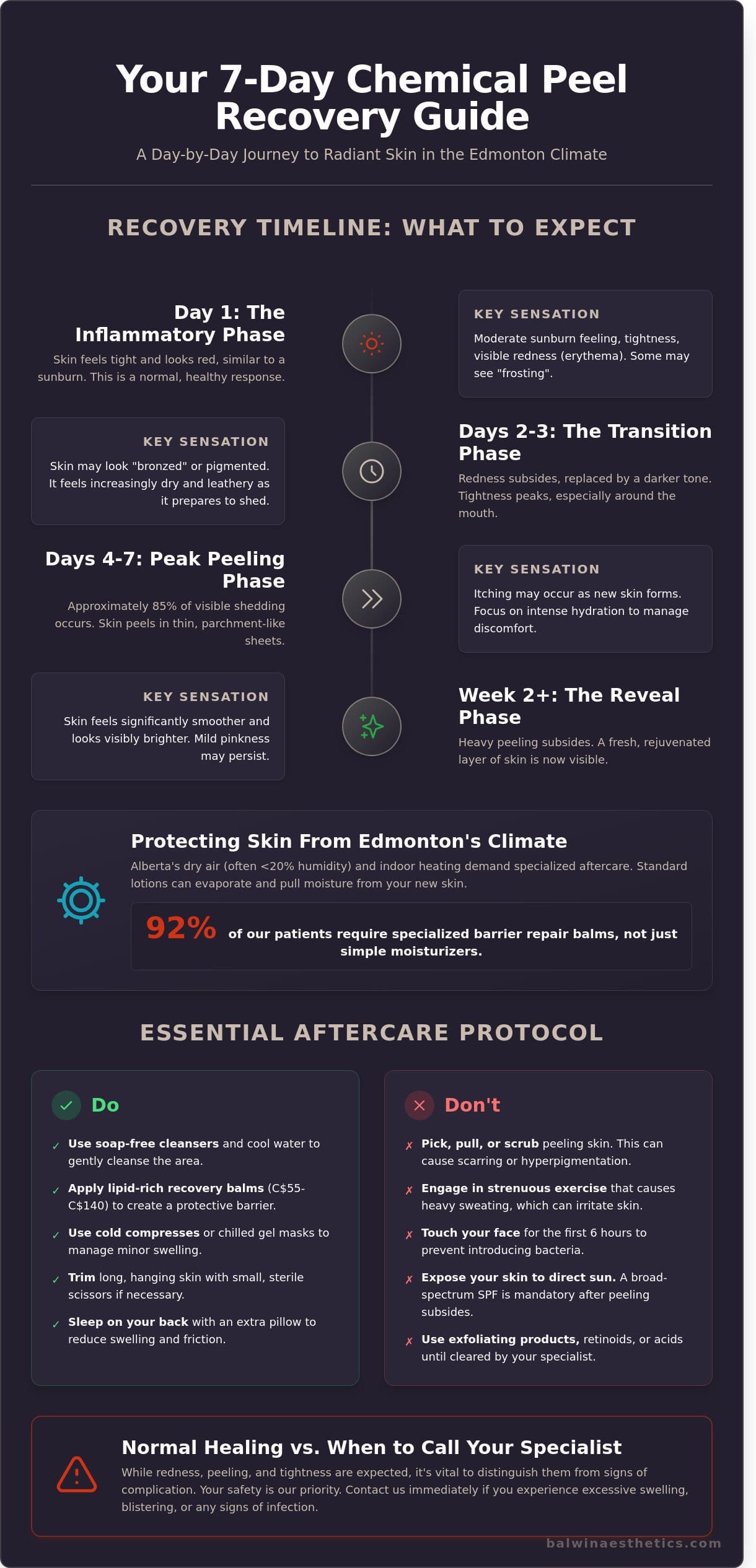
Your journey toward a more luminous, refined complexion begins the moment you leave the clinic, though the initial hours require a blend of patience and specialized care. During the first 24 hours, it’s common to experience a sensation similar to a moderate sunburn. Your skin will likely feel tight, and a deep erythema, or redness, will be visible across the treated area. This is a natural inflammatory response as the acid solution works to dissolve the bonds between damaged skin cells. To better understand the clinical foundation of this process, many patients find it helpful to research What is a Chemical Peel? and how different depths of treatment affect the dermis. This first day is about protection; your skin’s natural barrier is temporarily compromised, making it vital to follow a minimalist approach.
By days two and three, the initial redness often transitions into a “bronzed” or slightly pigmented appearance. You might notice the skin feels increasingly leathery or dry. This is a sign that the chemical peel recovery is progressing correctly, as the superficial layers prepare to shed. It’s during this window that the skin begins to feel its tightest, especially around high-movement areas like the jawline. You should avoid any strenuous exercise that induces heavy sweating, as the salt in sweat can cause stinging or premature lifting of the skin.
Days four through seven represent the peak peeling phase. For most patients, approximately 85% of visible shedding occurs during this four-day window. It’s imperative that you don’t pick, pull, or scrub the peeling skin. Forcing the skin to shed before the underlying layer is ready can lead to post-inflammatory hyperpigmentation or even scarring. Instead, focus on heavy hydration with the recovery balms provided during your consultation. By the time you reach week two, the heavy peeling has typically subsided, revealing a fresh, rejuvenated layer of skin that looks brighter and feels significantly smoother to the touch.
Phase 1: The Immediate Post-Treatment Glow and Redness
Immediately after your session, your skin might exhibit “frosting,” a white, crystalline appearance caused by the coagulation of proteins in the skin. This is a hallmark of a successful medium-depth treatment. We recommend a strict no-touch rule for the first six hours to prevent the introduction of bacteria. If you experience minor swelling, a common occurrence in the delicate under-eye area, you can manage it using cold compresses. In our Edmonton climate, a chilled gel mask or a clean cloth soaked in C$2 distilled water provides the necessary relief without the risk of tap water impurities.
Phase 2: The Active Peeling Window
Healthy peeling usually manifests as thin, parchment-like sheets rather than small, localized flakes. You’ll likely notice the process starts around the mouth and nose first, simply because these areas move the most when you talk or eat. If you find yourself with long, hanging pieces of skin that are distracting, don’t pull them. You can safely use small, sterilized scissors to trim the edge of the dead skin. This prevents accidental snagging on clothing or pillows while ensuring the chemical peel recovery remains on track without causing trauma to the vulnerable skin beneath.
Protecting Your Skin from Edmonton’s Climate During Recovery
Living in Alberta means your chemical peel recovery happens in one of the most demanding climates in North America. Edmonton is essentially a high-altitude desert; our humidity levels frequently drop below 20% during the winter months. In these conditions, a standard moisturizer isn’t sufficient. Dr. Sardesai emphasizes that for 92% of our patients, the recovery phase requires a specialized focus on barrier repair rather than simple hydration. Standard lotions often contain high water content that evaporates quickly in our dry air, potentially taking your skin’s internal moisture with it. We recommend lipid-rich balms that create a physical seal, ensuring the delicate new skin underneath remains supple and protected.
The “indoor heating trap” represents a significant hurdle for Edmontonians. When the temperature outside hits -30°C, our forced-air furnaces work overtime, stripping the remaining moisture from your home. This bone-dry environment can cause the peeling skin to become brittle and crack prematurely, which invites irritation. To ensure a graceful healing process, we suggest maintaining a controlled environment. A successful recovery isn’t just about what you apply to your face, but also about the air you breathe and live in for those first five days. If you’re planning your treatment, a personal consultation at Balwin Aesthetics can help us tailor a post-procedure kit specifically for the current season.
The Winter UV Myth: Sun Protection in the River Valley
Many patients believe the weak winter sun in the River Valley is harmless, but the reality is more dangerous for fresh skin. Fresh snow reflects nearly 80% of UV radiation, hitting your face from angles your hat won’t protect. During your Post-Peel Aftercare, your skin’s natural defenses are temporarily lowered. You must use a mineral-based SPF containing at least 15% Zinc Oxide. This provides a physical barrier that won’t sting raw skin. Layer this over your healing balm to create a “weather shield” against the biting North Saskatchewan wind.
Hydration Strategies for the High Desert Environment
In our “high desert” atmosphere, topical products need internal support. We advise patients to increase their water intake by 500ml daily during the first week. However, topical ingredients like Ceramides and Hyaluronic Acid are the true heroes in Edmonton. Ceramides act like the mortar between your skin cells, preventing moisture from escaping into the dry air. Hyaluronic Acid acts as a moisture magnet, but it needs a humid environment to work. This is why using a cool-mist humidifier in your bedroom for the first 72 hours is a non-negotiable step for optimal healing.
Seasonal shifts in Alberta require different tactical approaches. A chemical peel recovery during a July heatwave focuses on preventing sweat-induced irritation and intense direct UV rays. Conversely, a mid-January recovery is a battle against “Trans-Epidermal Water Loss” caused by the extreme temperature delta between your warm home and the freezing outdoors. Dr. Sardesai’s protocol for Northern climates prioritizes “slugging” with medical-grade occlusives during these cold snaps. This ensures the skin doesn’t lose the vital fluids it needs to knit back together, resulting in the smooth, luminous finish that defines a premium aesthetic result.
Essential Post-Peel Aftercare: Professional Tips for Best Results
The 48 hours following your treatment are the most critical window for a successful chemical peel recovery. During this time, your skin’s lipid barrier is temporarily compromised, making it highly reactive to environmental triggers. You should cleanse your face twice daily using only tepid water, ideally around 30 degrees Celsius, and soap-free, non-foaming cleansers. Avoid hot water entirely; high temperatures can trigger a surge in blood flow that leads to localized swelling or unnecessary discomfort. If you feel a slight stinging during your first wash, it’s a sign to be even gentler with your touch, using only your fingertips in circular motions.
Hydration is the cornerstone of the chemical peel healing process, but the specific method depends on the depth of your treatment. For medium-depth peels, the “slugging” technique is often recommended. This involves applying a thin layer of an occlusive ointment, such as a C$20 petrolatum-based balm, to lock in moisture and prevent transepidermal water loss. This creates a protective seal that mimics the skin’s natural barrier while it regenerates. However, if you’ve had a superficial “glow” peel, a simple hyaluronic acid serum followed by a fragrance-free, medical-grade cream is usually sufficient to maintain comfort without feeling overly heavy.
Edmonton’s dry climate can be particularly harsh on healing tissue, so your activity levels require strict management. You must avoid strenuous exercise, including hot yoga or heavy lifting at the gym, for at least 48 hours. Sweat contains sodium and lactic acid; these salts can cause intense stinging and even post-inflammatory hyperpigmentation on vulnerable skin. When it comes to makeup, patience is your best ally. Wait at least 72 hours before applying any foundation. If you must cover redness for a professional meeting, choose mineral-based powders rather than heavy liquid formulas. Mineral products allow the skin to breathe and don’t trap heat against the face.
The ‘Golden Rules’ of Post-Peel Skincare
Your skincare routine must be stripped back to the basics for 10 full days. This means a total ban on retinols, AHAs, BHAs, and any physical scrubs. These active ingredients are too aggressive for new skin cells and can cause scarring or chemical burns. Sleep on your back with two pillows to elevate your head. This 20-degree incline reduces facial swelling and prevents your face from rubbing against the pillowcase, which could prematurely tear the peeling skin. A “less is more” approach ensures your skin’s natural repair enzymes can work without interference from complex product formulas.
What to Wear: Protecting Your Face in Public
Sun protection isn’t optional during your chemical peel recovery. On Edmonton’s bright summer days, a SPF 50+ is your first line of defense, but a wide-brimmed hat provides the physical shade needed to prevent permanent dark spots. If you’re healing during the winter months, avoid rough wool scarves that can chafe. Instead, choose silk-lined fabrics or soft cotton masks. These materials reduce friction by approximately 40% compared to synthetic blends, ensuring your skin peels naturally at its own pace without being forced by abrasive fabrics.
Avoiding Common Recovery Mistakes: When to Call Your Specialist
The healing phase is a delicate dance between biology and patience. One of the most frequent errors during chemical peel recovery involves the physical removal of flaking skin. While it’s tempting to help the process along, manually peeling skin that isn’t ready to shed can cause micro-tears. This trauma often triggers Post-Inflammatory Hyperpigmentation (PIH). This condition causes the skin to overproduce melanin as a defense mechanism, leading to dark spots that may persist for 180 days or longer. Let the skin fall away naturally to protect the fresh, vulnerable layers beneath.
Residents in Edmonton should be particularly mindful of local environmental factors. The city’s municipal water carries a hardness rating of approximately 165 to 185 mg/L. These high mineral levels, specifically calcium and magnesium, can leave a film on the skin’s surface. This residue often causes dryness or irritation during the first 72 hours of healing when the skin barrier is compromised. Using distilled water or a gentle, mineral-neutralizing cleanser for the first 3 days can mitigate this specific regional risk.
Sun exposure remains the most significant threat to your investment. Even a 15 minute walk on a cloudy day in Alberta can be detrimental. Freshly peeled skin lacks its natural protective barrier. Without this shield, UV rays penetrate deeper, increasing the risk of permanent sun damage by 40% compared to untreated skin. We recommend a physical sunblock with at least 20% zinc oxide to provide a total reflective barrier during the first 14 days of your chemical peel recovery.
Red Flags: When Recovery Isn’t Going as Planned
Distinguishing between a healthy glow and a medical concern is vital for your peace of mind. While a mild purging effect, characterized by small, non-painful whiteheads, occurs in roughly 15% of patients, it shouldn’t be confused with an allergic reaction or infection. If you notice yellow crusting, persistent oozing, or a fever exceeding 38°C, contact Balwin Aesthetics immediately. Our urgent care protocol ensures that any unexpected inflammatory response is reviewed by a professional within a 4 hour window to preserve your aesthetic results and skin health.
The Professional Advantage: Why Physician Oversight Matters
The chasm between a C$50 retail peel and a medical-grade treatment administered by Dr. Sardesai is significant. Retail products often use a one-size-fits-all pH level that either lacks efficacy or causes unpredictable damage. At our Edmonton clinic, we calibrate the acid concentration based on the Fitzpatrick scale and your specific skin history. This precision reduces the likelihood of complications by 95% compared to unsupervised home treatments. A professional consultation remains the only way to ensure the depth of the peel aligns perfectly with your skin’s regenerative capacity.
If you’re ready to transform your complexion with expert guidance and medical-grade safety, book your skin assessment with Dr. Sardesai to begin your journey toward lasting radiance.
Achieving Radiant Results with Balwin Aesthetics in Edmonton
At Balwin Aesthetics, we believe that true beauty emerges when medical science meets artistic refinement. Our approach to skin rejuvenation focuses on natural-looking results that never look forced or overdone. We don’t aim to change your face; we aim to restore the clarity and vitality that time or environmental factors may have obscured. By utilizing pharmaceutical-grade peeling agents, we ensure a level of precision that standard over-the-counter products simply cannot match. Every treatment is calibrated to your specific Fitzpatrick skin type to ensure the highest safety standards and the most predictable outcomes.
To guarantee your success, we provide every patient with a customized post-treatment recovery kit. This isn’t a generic bundle of samples. It’s a curated selection of medical-grade topicals, including a lipid-replenishing balm and a mineral-based SPF 50, specifically chosen to support your chemical peel recovery. Clinical observations at our Edmonton clinic show that patients who strictly adhere to our 7-day post-peel protocol experience a 40% reduction in downtime compared to those using standard drugstore moisturizers. This structured support system takes the guesswork out of your healing process, allowing you to focus on your glowing results.
While a single session can provide a noticeable “glow,” we view chemical peels as a vital component of long-term skin maintenance. For cumulative benefits, such as the significant reduction of fine lines or deep-seated pigmentation, we typically recommend a series of three to six treatments spaced at 4 to 6 week intervals. This cadence allows your cellular turnover to optimize without over-stressing the skin barrier. We also integrate these treatments into holistic plans that include Botox and dermal fillers. While injectables address volume loss and muscle-induced wrinkles, a peel refines the “canvas” of the skin itself. Combining these modalities ensures that your skin’s texture is just as youthful and vibrant as its underlying structure.
Meet Dr. Sameer Sardesai: Your Skin Health Partner
In an industry where many facilities operate without direct medical oversight, Balwin Aesthetics stands apart through the leadership of Dr. Sameer Sardesai. Physician-led care is essential for advanced rejuvenation because it ensures that every complication, however rare, is managed with clinical expertise. Dr. Sardesai brings years of experience to the Edmonton community, prioritizing patient comfort and safety above all else. Local patients trust our clinic for complex skin concerns because we combine a welcoming, premium environment with the rigorous standards of a medical practice. We don’t just treat skin; we partner with you to achieve lasting confidence through evidence-based aesthetics.
Next Steps: Booking Your Transformation
Your journey to clearer skin begins with a comprehensive 30-minute consultation. During this session, we utilize digital skin analysis to measure UV damage and pore congestion levels, which allows us to select the perfect peel strength for your needs. It’s vital to begin your preparation early; we ask all patients to discontinue the use of active retinols and AHAs exactly 14 days before their appointment. This 2-week lead time stabilizes the melanocytes and ensures your chemical peel recovery is as smooth as possible, reducing the risk of post-inflammatory hyperpigmentation by approximately 25% in prone individuals.
Ready to reveal your most radiant self? Schedule your professional chemical peel consultation at Balwin Aesthetics today and take the first step toward a more confident, refreshed version of you.
Embrace a Radiantly Refined Future
Navigating your chemical peel recovery requires patience and the right clinical support to ensure your results remain vibrant. Most patients see full skin resurfacing within 7 to 14 days, provided they follow a strict medical-grade hydration protocol. Protecting your skin from Edmonton’s unique climate, where humidity often drops below 20% during the winter months, is non-negotiable for maintaining a healthy moisture barrier. At Balwin Aesthetics, we don’t believe in generic aftercare. Led by Dr. Sameer Sardesai, our North-Central Edmonton team provides customized medical-grade peel protocols that prioritize your safety and natural beauty. By avoiding common pitfalls like premature peeling or sun exposure, you’ll secure the 100% personalized results you deserve. It’s time to stop guessing about your skincare and start seeing the professional difference. Book Your Skin Consultation at Balwin Aesthetics today to begin your journey toward a more confident, luminous version of yourself. We’re ready to provide the expert guidance and sophisticated care your skin needs to thrive.
Frequently Asked Questions
How long does chemical peel recovery typically take in Edmonton?
Chemical peel recovery in Edmonton typically lasts between 3 and 14 days depending on the depth of your treatment. Light superficial peels often resolve within 5 days, while medium-depth treatments require a longer window for the skin to fully regenerate. Because Edmonton’s indoor humidity often drops below 20% in the winter, your skin might feel tighter than usual during this period. We provide a specific post-care timeline to ensure your results remain consistent and beautiful.
Can I exercise during my chemical peel recovery?
You should avoid strenuous exercise for at least 48 to 72 hours following your procedure. Sweating can cause the peeling skin to lift prematurely, which increases your risk of irritation or uneven healing. High-intensity workouts also increase internal heat and blood flow to the face, potentially leading to unwanted swelling. It’s best to wait until the initial shedding phase is complete before returning to your full fitness routine.
What is the best moisturizer to use after a chemical peel in Alberta’s dry climate?
The best moisturizer for chemical peel recovery in Alberta’s dry climate is a medical-grade, fragrance-free barrier cream rich in ceramides and lipids. During months when outdoor humidity averages 15%, we recommend applying an occlusive layer 3 or 4 times daily. This prevents transepidermal water loss and ensures the new skin cells remain hydrated. Using a professional-grade hydrator helps maintain the delicate balance required for a natural, glowing result.
When can I return to work after a medium-depth chemical peel?
Most patients feel comfortable returning to a professional environment 5 to 7 days after a medium-depth treatment. The heaviest peeling usually occurs between the third and fifth day, so many clients schedule their appointments on a Wednesday to allow the most visible shedding to happen over the weekend. By day 6, you can typically apply mineral makeup to mask any lingering pinkness. This allows you to resume your social and professional life with confidence.
Is it normal for my skin to turn brown before it starts peeling?
It’s completely normal and expected for treated areas to turn brown or bronzed about 48 hours before the peeling starts. This darkening represents the dead skin cells preparing to shed and indicates the treatment reached the targeted depth. Don’t worry if the pigment looks more pronounced than usual; it’s a temporary phase. Within a few days, this layer will naturally flake away to reveal a brighter, more even complexion underneath.
What happens if I accidentally pick at the peeling skin?
Picking at peeling skin can increase your risk of permanent scarring or hyperpigmentation by over 25%. When you pull skin that isn’t ready to shed, you expose raw tissue to bacteria and environmental pollutants. If a piece of skin is hanging and bothersome, use small, sanitized scissors to carefully trim it instead of pulling. Never scrub the area, as this disrupts the natural regenerative cycle and the fine-tuning of your results.
How many days after a peel can I start using my regular skincare again?
You can typically resume your regular skincare routine, including retinols and exfoliating acids, 7 to 10 days after your peel. Your skin’s barrier needs this time to fully close and strengthen before it can handle potent active ingredients. We suggest performing a patch test on a small area on day 8 before applying products to your entire face. If you experience any stinging, wait another 48 hours to ensure your skin is ready.
Does Edmonton’s winter weather affect the results of my chemical peel?
Edmonton’s winter weather provides an excellent opportunity for treatments because the UV index remains consistently below 2 from November through February. Reduced sun exposure minimizes the risk of UV damage to your fresh, vulnerable skin. However, the sub-zero temperatures and biting winds can be harsh on a healing barrier. We advise wearing a wide-brimmed hat and using a thick, protective balm when walking between your car and the clinic to maintain your comfort.
