
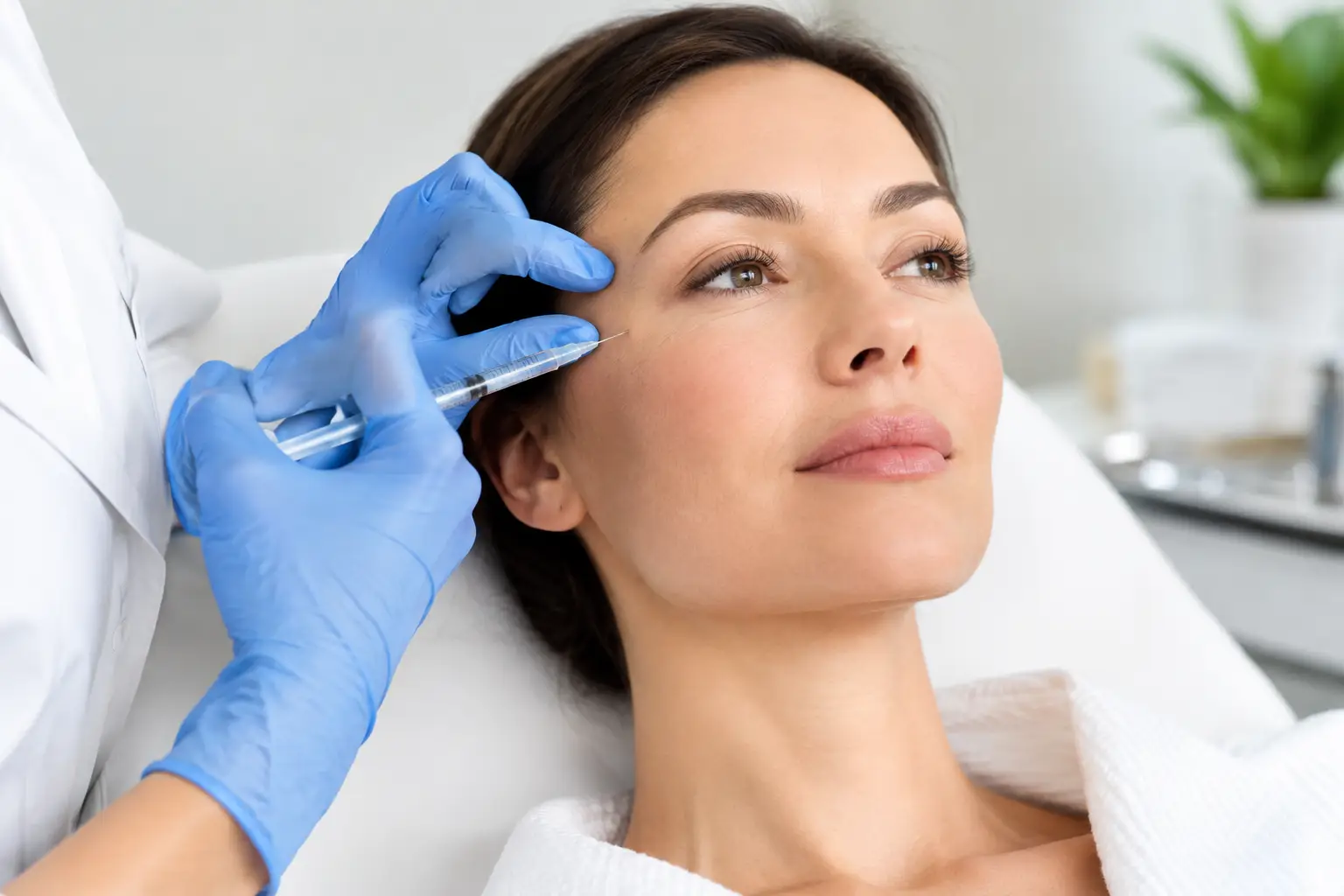
Expression lines tell a story, but they do not always reflect how rested or refreshed you feel. This guide to wrinkle relaxer treatments explains how these physician-administered injectables can soften dynamic lines while preserving the facial movement that makes your expressions uniquely yours.
What wrinkle relaxers are designed to treat
Wrinkle relaxers are injectable neuromodulators, commonly known by brand names such as Botox. They work by temporarily reducing the nerve signals that tell selected facial muscles to contract. When the targeted muscle relaxes, the skin above it has an opportunity to appear smoother.
These treatments are most effective for dynamic wrinkles: lines created by repeated movement. Common concerns include horizontal forehead lines, frown lines between the brows, and crow’s feet around the eyes. Depending on facial anatomy and treatment goals, wrinkle relaxers may also be used for a subtle brow lift, chin dimpling, neck bands, a gummy smile, or a softened jawline.
They do not work in the same way as dermal fillers. Fillers restore or refine volume, while wrinkle relaxers address the muscle activity that contributes to expression lines. Some patients benefit from one approach, while others achieve their most balanced result with a carefully planned combination of treatments.
A guide to wrinkle relaxer treatments and natural results
The best wrinkle relaxer result should not make you look unlike yourself. It should help you look more rested, polished, and at ease. Natural outcomes come from thoughtful assessment, precise placement, and an appropriate dose, not from treating every visible line.
A physician-led consultation begins with more than a close look at the wrinkle itself. Your injector should assess how your face moves at rest and in expression, the position of your brows, the strength of your facial muscles, skin quality, and the balance between facial areas. A strong forehead muscle, for example, may help support the brow. Treating it too aggressively without considering surrounding muscles can create a heavy or flat appearance.
Your preferences matter just as much. Some patients want very subtle softening and full expression. Others prefer a smoother, more polished look for professional photographs, events, or everyday confidence. Neither goal is inherently better. The right plan is the one that respects your anatomy, priorities, and comfort level.
What happens at a treatment appointment
After reviewing your health history and aesthetic goals, your provider will recommend a treatment plan tailored to the areas that concern you. The skin is cleansed, and a series of small injections is placed into selected muscles. Most appointments are brief, and the needles used are very fine.
You may notice small bumps, pinpoint redness, or mild tenderness at the injection sites immediately afterward. These effects usually resolve quickly. There is generally no extended downtime, which is one reason wrinkle relaxers are a popular option for people with full schedules.
For the rest of the day, follow the aftercare instructions provided by your treating clinician. Patients are commonly advised to avoid rubbing or massaging treated areas and to postpone strenuous exercise, significant heat exposure, and lying flat for several hours. Recommendations can vary based on the product used and the areas treated, so your provider’s instructions should take priority over general advice.
When you will see results and how long they last
Wrinkle relaxers do not produce an instant final result. Many patients begin seeing a change within three to seven days, with the effect continuing to settle over approximately two weeks. This gradual onset allows the treated muscles to relax while your appearance remains natural.
Results often last about three to four months, although this varies. Metabolism, muscle strength, dosage, treatment area, and prior treatment history can all affect longevity. Patients with stronger facial movement may need a different dosing strategy than those seeking maintenance after several sessions.
Consistency can be useful, but treatment should never become automatic. Your plan may change as your goals, facial anatomy, and skin needs change. A qualified injector will reassess rather than simply repeat the same pattern at every visit.
Safety starts with the injector
Wrinkle relaxers have a well-established medical and cosmetic history when they are prescribed and administered appropriately. Still, they are medical treatments, not a casual beauty service. Product selection, dose, injection depth, and placement all influence both safety and aesthetic outcome.
The most common temporary effects include redness, swelling, tenderness, bruising, or a mild headache. Less common complications can include asymmetry, a temporary drooping eyelid or brow, or an unintended change in movement. These possibilities are precisely why clinical training and detailed facial knowledge matter.
Tell your provider about your complete medical history, medications and supplements, allergies, previous cosmetic procedures, and any history of neuromuscular conditions. Treatment may need to be postponed or may not be appropriate during pregnancy or breastfeeding, with certain neurologic conditions, or when there is an active skin infection at the intended injection site. An informed consultation is not an extra step. It is part of safe care.
Choosing the right time for treatment
There is no single “right age” to begin wrinkle relaxer treatments. Some adults seek treatment when expression lines remain visible after the face is relaxed. Others choose preventative treatment before those lines become more etched into the skin. The decision depends on your skin, facial movement, goals, and comfort with maintenance.
It is also wise to plan around major events. Since bruising is possible and the final result can take up to two weeks to develop, schedule well before a wedding, presentation, photo session, or vacation. First-time patients may appreciate an earlier appointment so there is time to evaluate the result and make a conservative adjustment if clinically appropriate.
Pairing wrinkle relaxers with skin renewal treatments
Relaxing muscle movement can soften expression lines, but it does not replace a complete skin-quality plan. Concerns such as pigmentation, enlarged pores, acne scarring, sun damage, dehydration, and laxity respond to different approaches. Microneedling, chemical peels, laser treatments, medical-grade skincare, and other physician-guided services may be considered when appropriate.
This distinction is useful because smooth skin is not created by one injectable alone. A patient may have beautifully relaxed frown lines but still feel concerned about uneven texture or discoloration. Addressing the right concern with the right treatment helps avoid overcorrecting one area in an effort to solve a different issue.
At Balwin Aesthetics, treatment planning centers on refined, natural-looking results and clear medical guidance. The goal is not to chase a frozen ideal. It is to create an approach that supports how you want to look and feel, with care that is personalized to your face.
A well-timed consultation can replace uncertainty with a plan that feels considered, conservative, and entirely your own.
