
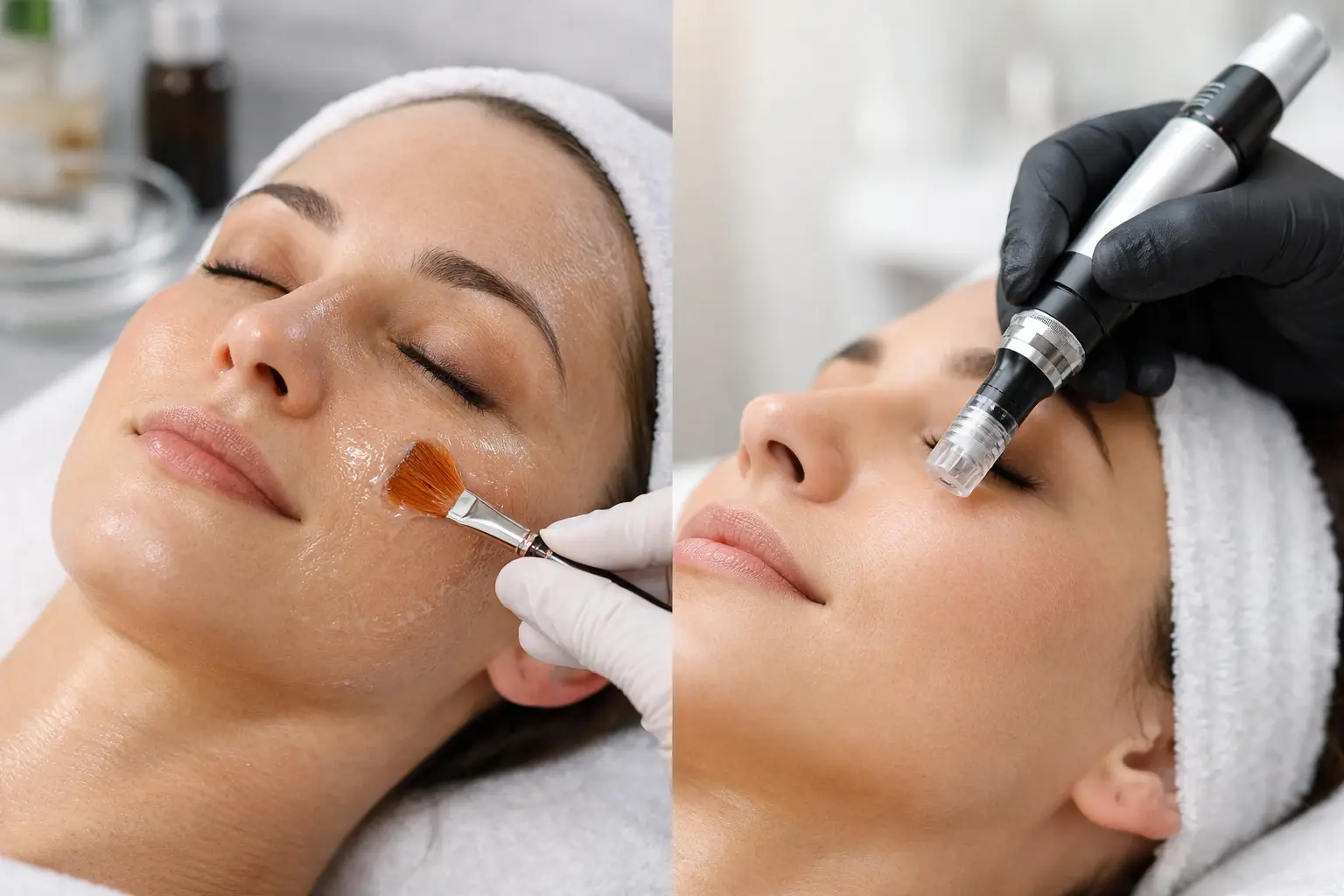
If you are weighing chemical peel vs microneedling, the real question is not which treatment is better overall. It is which one is better for your skin, your goals, and your tolerance for downtime. Both are proven options for skin renewal, but they work in very different ways. Choosing well matters because the right treatment can improve tone, texture, acne marks, and early signs of aging, while the wrong one may leave you underwhelmed or irritated.
At a glance, chemical peels use controlled exfoliation to resurface the skin, while microneedling creates tiny, precise micro-injuries that stimulate collagen production. That distinction shapes everything else, from how each treatment feels to what it treats best.
Chemical peel vs microneedling: the core difference
A chemical peel applies a solution to the skin to loosen and remove damaged outer layers. Depending on the type and strength of peel, this can target surface dullness, uneven pigment, acne, and fine lines. Some peels are very light and involve minimal visible peeling. Others are more intensive and require a longer recovery period.
Microneedling does not remove skin layers in the same way. Instead, it uses fine needles to create controlled microchannels in the skin. This triggers the body’s repair response and encourages new collagen and elastin. Over time, that can improve acne scarring, texture irregularities, enlarged pores, and mild laxity.
That is why these treatments are often compared, but not always interchangeable. One is primarily resurfacing. The other is primarily collagen-stimulating.
What a chemical peel does best
Chemical peels are often a strong option when the concern sits closer to the skin’s surface. If your skin looks tired, rough, congested, or uneven in tone, a peel may deliver a quicker visible refresh. They can be particularly helpful for sun damage, post-inflammatory pigmentation from breakouts, and certain forms of acne.
Peels also come in a range of strengths, which allows a treatment plan to be adjusted based on your skin type, sensitivity, and goals. A lighter peel may be chosen for brightening and maintenance, while a medium-depth option may be more appropriate for more noticeable discoloration or textural change.
The trade-off is that peels can be less predictable if your skin is reactive or if you are prone to post-treatment pigmentation. This does not mean they are unsafe. It means proper skin assessment and product selection matter. Skin tone, current skincare use, and recent sun exposure all influence how well a peel is tolerated.
What microneedling does best
Microneedling tends to stand out when the goal is structural improvement rather than surface exfoliation alone. It is commonly recommended for acne scars, crepey texture, early fine lines, and skin that needs firmer, smoother support over time. Because it stimulates collagen, results continue to develop in the weeks after treatment.
Many patients also like microneedling because it can be used across different skin types with the right settings and technique. For deeper textural issues, especially acne scarring, it is often a more logical choice than a superficial peel.
The main trade-off is patience. Microneedling is not usually the treatment people choose for an immediate glow before an event. Skin may look pink for a day or two, and the most meaningful improvements generally build across a series. It is a treatment for gradual, quality-focused change.
Which treatment is better for acne scars, pigment, and fine lines?
This is where the comparison becomes more specific.
For acne scars, microneedling often has the advantage, especially when scars are depressed or textural. A peel may improve the discoloration left behind by acne, but it usually will not do as much for scar depth.
For pigmentation, chemical peels are often the more direct option, especially for sun damage, blotchiness, and post-acne marks near the surface. That said, not every pigment issue should be treated with a peel. Melasma and deeper pigment disorders can be more complex and may worsen with the wrong approach.
For fine lines, it depends on what is causing them. If the skin looks dull and dry with very superficial lines, a peel can improve the appearance quickly. If the issue is collagen loss or crepey texture, microneedling may offer more meaningful long-term improvement.
For active acne, the answer is also nuanced. Some peels can help reduce congestion and breakouts. Microneedling is generally not performed over inflamed active acne because of irritation and spread risk. In that situation, a peel may be the more appropriate starting point.
Downtime and what recovery really looks like
Patients often ask which treatment has less downtime. The honest answer is that it depends on the type of peel and the intensity of the microneedling session.
A light peel may leave the skin a little pink and dry for a few days, with mild flaking that is easy to manage. A stronger peel can involve visible peeling, tightness, and more social downtime. You need to be disciplined with sun protection after any peel, because the skin is more vulnerable during recovery.
Microneedling typically causes redness, warmth, and a tight feeling for one to three days. Some patients describe it as looking like a mild sunburn. There may be slight swelling or roughness as the skin heals. Most people return to normal routines quickly, but you still need gentle aftercare and sun avoidance.
If your schedule cannot accommodate visible peeling, microneedling may feel easier. If you want a faster brightening effect and are comfortable with a few days of flaking, a peel may fit well.
Chemical peel vs microneedling for sensitive or darker skin
This is one of the most important parts of the decision. Not every treatment suits every skin type in the same way.
Sensitive skin may react strongly to acids, especially if the skin barrier is already compromised from retinoids, exfoliants, or overuse of active products. In those cases, a peel needs to be chosen very carefully or delayed until the skin is calmer.
Darker skin tones require thoughtful treatment planning because both peels and microneedling can trigger post-inflammatory hyperpigmentation if performed incorrectly. That does not rule either treatment out. It means physician-led assessment, conservative settings, proper skin prep, and aftercare are essential. This is where medical oversight makes a real difference.
Can you combine them?
Sometimes, yes, but not usually on the same day unless there is a specific physician-directed protocol. These treatments can complement each other when timed properly. For example, a patient dealing with both pigment and acne scarring may benefit from a treatment plan that includes peels at one stage and microneedling at another.
Combination planning should be strategic rather than aggressive. More treatment is not always better. Skin responds best when the right intervention is used at the right time, with enough healing between sessions.
How to choose the right option for your skin
The best choice comes down to what bothers you most when you look in the mirror. If you see discoloration, dullness, sun damage, and surface roughness, a chemical peel may be the better starting point. If you notice acne scarring, enlarged pores, textural irregularity, or early skin laxity, microneedling may offer more value.
Your timeline matters too. If you want a refresh before an event, a light peel may produce visible brightening sooner. If you are focused on collagen support and texture improvement over the next few months, microneedling is often the more strategic investment.
This is also why consultation matters. A good provider is not simply matching you to a popular treatment. They are looking at your skin type, your history, your skincare routine, and the result you actually want. At Balwin Aesthetics, that kind of personalized planning is central to achieving results that look refined and natural.
If you are stuck between the two, that usually means your skin has more than one concern, not that you are choosing wrong. The most useful next step is not guessing. It is getting a professional assessment that turns a general comparison into a plan built for your face, your skin, and your goals.
