
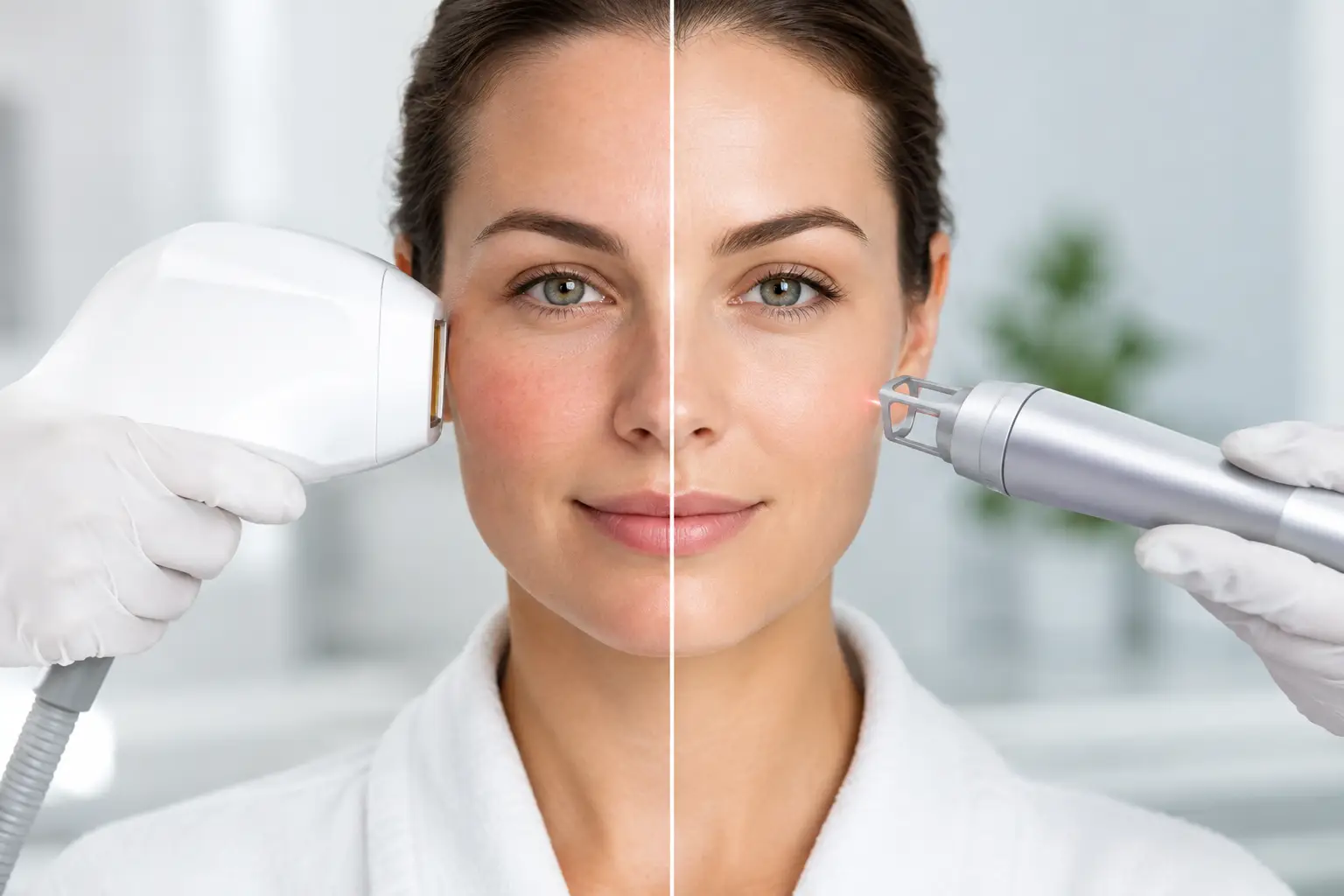
Persistent facial redness can make skin look irritated even when it feels calm. Visible capillaries around the nose, flushed cheeks, and red marks left after acne often respond poorly to skincare alone. When comparing IPL versus vascular laser, the best choice is not simply the stronger treatment. It is the treatment that matches the cause of the redness, your skin tone, and the result you want to achieve.
Both options use light-based technology, but they work differently. A thoughtful assessment helps determine whether one treatment, a series, or a combination approach is most appropriate for clear, balanced, natural-looking skin.
IPL Versus Vascular Laser: The Core Difference
IPL, or intense pulsed light, is not technically a laser. It delivers broad-spectrum pulses of light that can be filtered to target pigment and blood vessels in the skin. Because it addresses more than one concern at a time, IPL is often selected for overall photorejuvenation – particularly when redness appears alongside sun spots, uneven tone, or diffuse discoloration.
A vascular laser uses a specific wavelength designed to be absorbed by hemoglobin, the pigment in red blood cells. This makes it highly focused for visible vessels and redness-related concerns. The energy heats the targeted vessel while aiming to leave the surrounding skin intact.
In practical terms, IPL is often a versatile option for generalized redness and uneven complexion, while a vascular laser is typically the more precise choice for defined broken capillaries, cherry angiomas, or more persistent vascular redness. There is overlap, which is why the diagnosis behind the redness matters more than choosing a device by name.
When IPL May Be the Better Option
IPL can be an effective choice for patients whose concerns are broad rather than limited to a few individual vessels. Many patients appreciate that it can improve several visible signs of sun exposure in the same treatment plan, including brown spots, diffuse redness, freckles, and a dull or uneven-looking complexion.
It is commonly considered for photodamage on the face, neck, chest, and hands. If your cheeks look generally flushed and you also notice sun-related pigment, IPL may offer a more comprehensive approach than a vessel-specific laser alone.
Treatment is usually performed as a series. Brown spots may temporarily darken before they flake away, while redness tends to improve gradually over several sessions. The skin can look mildly pink afterward and may feel warm, similar to a light sunburn, but downtime is generally limited.
IPL is not suitable for every skin tone or every concern. Since it targets melanin as well as hemoglobin, there can be a higher risk of unwanted pigment changes when treatment settings are not carefully selected for the patient’s skin type, recent sun exposure, and history of hyperpigmentation. A physician-led consultation is especially valuable for determining whether IPL can be performed safely and effectively for your complexion.
When a Vascular Laser Is the Better Fit
A vascular laser is designed for precision. It may be recommended when you can clearly see red, purple, or blue vessels on the skin, particularly around the nostrils, cheeks, chin, or legs. It can also be used for cherry angiomas, certain red acne marks, and redness associated with rosacea, depending on the individual presentation.
Because the wavelength is selected specifically for vascular targets, treatment can be more direct than IPL for distinct broken capillaries. Tiny vessels may fade immediately, while others can darken or become temporarily more noticeable before gradually clearing. Larger or deeper vessels often require more than one session.
The recovery experience depends on the device, treatment area, and settings used. Some patients have redness and mild swelling for a day or two. More intensive vessel treatment can occasionally cause brief bruising or small areas of swelling. These effects are usually temporary, but they should be factored into scheduling if you have an upcoming event.
A vascular laser is not necessarily the answer for every red complexion. Rosacea-related flushing, for example, can involve visible vessels, inflammation, triggers, and sensitivity. Laser treatment may improve visible redness, but it does not remove the underlying tendency to flush. The best outcomes often combine in-clinic treatment with a personalized skincare routine and practical trigger management.
What Each Treatment Can and Cannot Treat
The concern being treated should guide the technology. IPL is often a strong option when skin has a mixed pattern of brown and red discoloration. A vascular laser is often preferred for individual capillaries and red vascular lesions that need focused treatment.
Neither treatment is intended to replace medical evaluation of a new, changing, bleeding, or suspicious lesion. Likewise, not all redness is vascular. Irritation from active skincare ingredients, eczema, contact dermatitis, acne inflammation, and certain medications can create a red appearance that requires a different plan.
It is also helpful to set realistic expectations. Light-based treatments can significantly reduce visible redness and discoloration, but they cannot stop new vessels from forming over time. Genetics, sun exposure, rosacea, hormonal changes, and lifestyle factors can all contribute to recurring concerns. Maintenance treatments may be appropriate for some patients who want to preserve their results.
Safety Depends on More Than the Device
The quality of a light-based treatment is not defined by the machine alone. Skin assessment, diagnosis, settings, treatment technique, and aftercare all influence safety and outcomes. A treatment that is ideal for one person may be too aggressive, too conservative, or simply not the right modality for another.
Before IPL or vascular laser treatment, your provider should review your skin tone, tanning history, medications, skincare products, history of cold sores, and tendency toward pigmentation changes or scarring. Certain medications and topical products may need to be paused before treatment. Recent tanning, self-tanner, and significant sun exposure can increase risk and may mean treatment should be postponed.
After treatment, gentle care and daily broad-spectrum sunscreen are essential. Avoiding heat exposure, vigorous exercise, hot baths, and active exfoliating products for the period recommended by your provider can help support comfortable healing. If crusting, blistering, increasing pain, or unexpected changes occur, contact the treating clinic promptly rather than trying to manage the area with home remedies.
How Many Treatments Will You Need?
Most patients need a series rather than a single session. The number depends on the concern, vessel size, depth, skin response, and whether the goal is broad complexion renewal or targeted vessel clearance.
For IPL, a plan may include several treatments spaced a few weeks apart, followed by maintenance as needed. Vascular laser treatment can sometimes clear a small, isolated vessel quickly, but diffuse redness and larger vessels usually require multiple sessions. Your provider should explain what is realistic for your specific skin before treatment begins, including the possibility that some vessels may respond differently than others.
Photos taken under consistent lighting can be useful during a treatment plan. Redness is easy to judge differently from day to day, especially when skin is influenced by temperature, exercise, makeup, or stress. Comparing standardized images allows progress to be evaluated more objectively.
Choosing the Right Treatment for Your Skin
The question is rarely whether IPL or vascular laser is universally better. It is whether your concern is primarily pigment, diffuse redness, distinct vessels, rosacea-related changes, or a combination of several factors. Your skin tone and history of sensitivity are equally important in determining a safe approach.
A personalized consultation should include a close examination of the area, a discussion of your medical and skincare history, and clear guidance on expected results and recovery. At Balwin Aesthetics, treatment planning is centered on physician-led assessment and refined results that support healthy-looking skin without overcorrecting it.
The most satisfying results usually begin with a precise diagnosis, not a one-size-fits-all treatment choice. When redness or discoloration is evaluated carefully, light-based treatment can become a measured, effective part of a longer-term skin renewal plan.
