
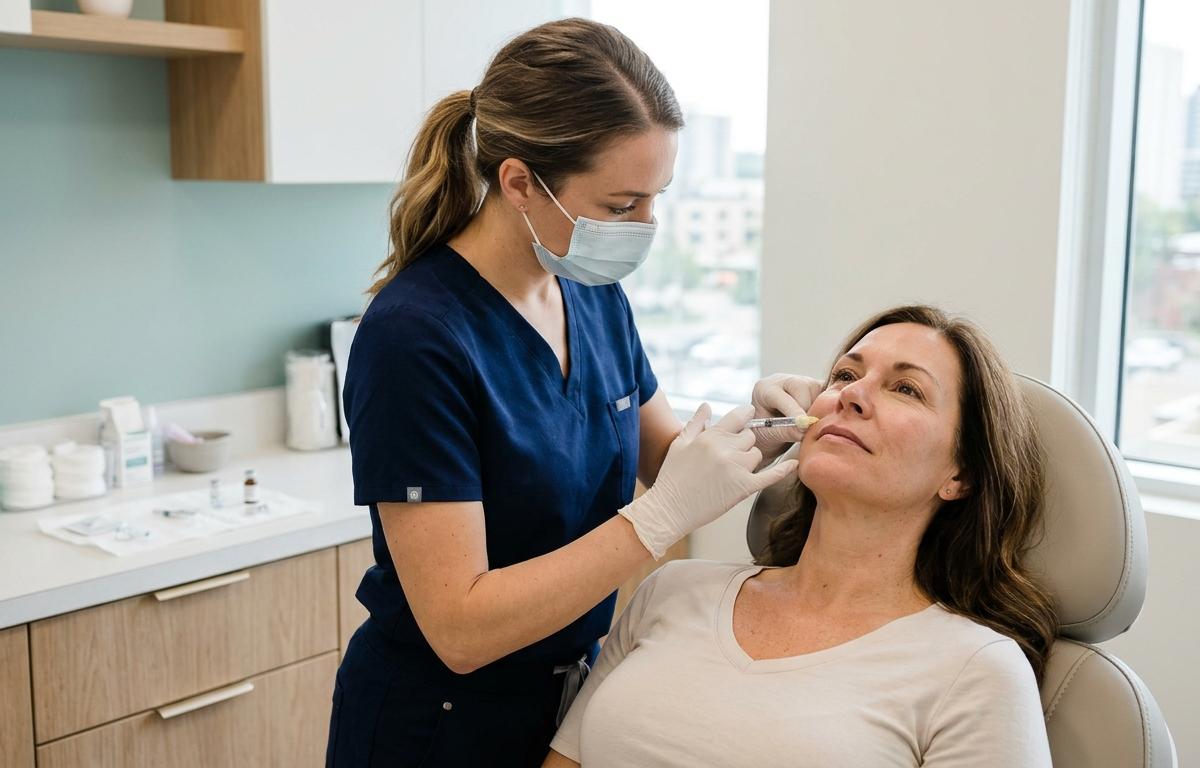
What Nasolabial Folds Are and Why They Deepen
Nasolabial folds are the creases that run from the sides of the nose down toward the corners of the mouth. You may hear them called smile lines or nasal folds. They are often one of the first things people point to when they ask what is making them look older or more tired.
It is tempting to treat these folds as a line problem, but they are usually a volume and support problem. With age, the cheek fat pads lose volume and slide downward, and the midface flattens. Clinical trial documentation for nasolabial fold filler notes that midface flattening and medial displacement of the cheek exaggerate how deep the fold looks (trial protocol for Princess FILLER Lidocaine). The fold deepens partly because the tissue above it no longer holds it up. Skin elasticity, sun exposure, repeated facial movement and individual bone structure all play a part too.
That shapes what dermal fillers nasolabial folds treatment can realistically do. A shallow fold in someone with good cheek support often responds beautifully to direct filler. A deep fold on a flattened midface may look better if we restore the cheek first and soften the fold second. At Balwin Aesthetics, our physician-led approach starts by working out which situation you are in, rather than placing product in the crease simply because that is where the shadow falls.
How Dermal Fillers Soften Smile Lines and What Results Look Like
Hyaluronic acid (HA) fillers are the most widely used filler type in Europe and the USA, and they are the usual choice for dermal fillers nasolabial folds, which is the clinical name for smile lines (PMC multicentre study of nasolabial fold filler). HA is a sugar molecule your body already makes. In a filler it is cross-linked into a smooth gel that adds volume, supports the tissue and holds water.
HA products are not interchangeable. They differ in cross-linking, concentration, viscosity, stiffness and the force needed to inject them. A softer gel moves naturally with expression and suits finer lines, while a firmer gel gives more structure to a deeper fold. Picking the right one is part of the clinical judgment, which is why the consultation matters more than the brand on the syringe. For a broader look at the options, our page on dermal fillers in Edmonton explains how we match products to treatment areas.
What results look like. With smile lines, the aim is softening, not erasure. A well-treated fold is shallower, the shadow along it is lighter, and the lower face looks more rested while still moving normally when you smile. Over-filling the crease is a common mistake. It can look heavy and unnatural, and it can make the midface appear fuller than intended. You will see a result straight away, though mild swelling or tenderness can make the first few days look a little different from the final outcome. Most people judge the true result at around two weeks, once the swelling has settled.
Expect a realistic change rather than a dramatic one. Filler can make a smile line look meaningfully softer. It will not remove a fold that is driven by significant skin laxity or tissue descent.
How Long Results Last and What Filler Costs in Alberta
Duration of dermal fillers nasolabial folds treatment depends on the product, injection depth, your metabolism and how much the area moves. Published and clinic-reported figures conflict. One clinic source describes roughly 6 to 18 months for nasolabial fold filler, while manufacturer information for some firmer HA products cites up to about 12 months in this area. The honest answer is a range. Plan on several months to a year or more, and expect the result to fade gradually rather than vanish overnight. Many patients book maintenance before the filler has fully worn off, which can mean less product is needed over time.
Cost. Filler is priced per syringe, and how many you need depends on the depth of your folds and whether cheek support is part of the plan. We do not quote a single Alberta figure here, because pricing depends on the product and the treatment plan assessed at consultation. Be wary of US per-syringe figures you find online. They come from clinics in a different market and are not a reliable guide to Canadian pricing. To see how we approach transparent pricing on injectables generally, read our guides to the cost of Botox in Edmonton and how much a unit of Botox costs. For an accurate filler number, the best step is to book an assessment and receive a written plan.
Safety, Vascular Occlusion Risks and When to Seek Urgent Care
Most filler side effects are mild and short-lived: tenderness, swelling, redness and small bruises. The one serious complication is vascular occlusion, and it is worth understanding before you book.
Vascular occlusion happens when filler blocks or compresses a blood vessel and cuts blood flow to the skin. It is a risk with all fillers, and a case report notes it is particularly relevant in areas such as the nasolabial folds, where major arteries run close to the surface (PMC case report on filler-induced vascular occlusion). Cleveland Clinic describes it as rare but serious (What Is a Vascular Occlusion?).
There is reassuring data. A systematic review reports an overall incidence below 1 percent, with early vascular compromise in about 0.07 percent of procedures, and over 90 percent of cases resolved completely when promptly recognised and treated (systematic review of vascular occlusion after filler). Speed drives that outcome. An ASDS task force strongly recommends prompt high-dose hyaluronidase for skin vascular occlusion after HA filler (ASDS evidence-based recommendations). HA filler can be dissolved, which is a major safety advantage, and our page on whether dermal fillers are reversible covers this in more detail.
Seek urgent care immediately if, after filler, you notice:
- Severe or increasing pain beyond normal tenderness
- Skin that turns pale, white, blue, grey or mottled
- A dusky or lace-like pattern on the skin
- Blistering or skin that looks unusually dark
- Any change in vision, or headache with these signs
Contact your injector straight away, and go to an emergency department if you cannot reach them. Do not wait to see whether it passes. Choosing an experienced, medically trained provider who can recognise and treat this complication is the most important safety decision you will make.
Who Can Inject Fillers in Alberta and What to Expect at Consultation
In Alberta, filler and neuromodulator injections are treated as restricted activities under the Health Professions Act, and they have also fallen under regulated personal services rules since July 2020. In practice, injections should be performed by a regulated health professional acting within their scope, or under appropriate physician oversight, and never by an unlicensed operator. The rules are administered by the relevant professional colleges and Alberta Health, so confirm a provider’s credentials and ask who will actually be doing your injection. Dermal fillers are also regulated as medical devices by Health Canada, so ask which product is being used and make sure it is an approved one. Our overview of what to look for in an Edmonton Botox clinic applies the same vetting questions to any injectable provider.
What a good consultation includes. You should expect:
- A review of your medical history, medications and allergies
- An assessment of your whole face, not just the fold you point to
- A frank discussion of what filler can and cannot do for your anatomy
- An explanation of the product, the technique and the risks, including vascular occlusion
- A clear plan covering the number of syringes, cost, aftercare and follow-up
- Time to decide, with no pressure to treat on the same day
If a provider promises to "erase" deep folds in one visit, or cannot explain what they will do if something goes wrong, treat that as a red flag.
When Cheek Support or Other Treatments May Work Better
Sometimes the best answer is not more filler in the fold. When the midface has lost volume, placing support in the cheek can lift the tissue above the crease and soften the fold indirectly, often with a more natural look. Evidence on when to treat the cheek first versus the fold directly is limited, so this is a judgment your clinician makes after examining you. Our guide to facial balancing treatments explains how we think about proportion across the whole face.
Dermal fillers nasolabial folds treatment has limits, too. Deep folds with substantial skin laxity may be better served by combining approaches or considering other options, and in more advanced cases some people explore surgical lifting. Where skin quality is part of the problem, treatments that improve texture and collagen can complement filler. Microneedling and PRP support skin quality, and our guide to PRP facial rejuvenation outlines what to expect. Wrinkle-relaxing injections can address expression lines elsewhere but will not fill a fold (Botox treatment).
If you are considering dermal fillers nasolabial folds treatment, the most useful next step is an assessment. Contact us to book a physician-led consultation in Edmonton, where we will tell you honestly whether filler, cheek support or a combined plan is the right fit.
