
Last Updated: November 24, 2026
Quick Summary
Laser treatment for facial redness can work by targeting hemoglobin in enlarged blood vessels while leaving surrounding tissue largely untouched, though results vary with the cause, device, and your skin. It does not cure rosacea, and improvement is often temporary, requiring maintenance sessions.
- Vascular lasers use selective photothermolysis, heating vessel walls until they narrow or close.
- Pulsed dye laser suits discrete vessels but commonly causes bruising for several days.
- IPL covers diffuse redness and sun damage with mild redness and 1-2 days of downtime.
- A typical plan includes a test spot, two to four sessions, then periodic maintenance.
- Avoid treatment if pregnant, breastfeeding, recently on isotretinoin, or prone to keloid scarring.
Table of Contents
- Does laser treatment for facial redness really work?
- How vascular lasers target blood vessels
- Laser treatment for rosacea: calming vascular redness
- IPL for facial redness: what broadband light can and cannot do
- Laser treatment for broken capillaries on face
- Comparing vascular laser and light devices
- Your treatment journey, session by session
- Risks, downtime, and who should avoid treatment
- Book a facial redness consultation at Balwin Aesthetics
- Frequently Asked Questions
Does laser treatment for facial redness really work?
Laser treatment for facial redness can reduce visible redness for some people, though results vary with the cause, the device used, and your skin. Vascular lasers deliver concentrated light that targets hemoglobin in enlarged blood vessels while leaving surrounding tissue largely untouched. This guide explains which devices suit which redness patterns and what recovery generally involves. (Source: Canadian Dermatology Association’s public information on rosacea)
Facial redness is rarely one condition. It can come from rosacea, sun damage, broken capillaries, or a naturally reactive complexion, and each responds differently to light-based care. That distinction matters more than the brand name on the machine.
The Canadian Dermatology Association’s public information on rosacea notes that rosacea is common and often under-recognized, which is one reason so many people arrive at a consultation unsure what they are actually treating.
Below, we walk through how the technology works, which options fit which pattern, and what a realistic outcome looks like.
How vascular lasers target blood vessels
Vascular lasers work through selective photothermolysis: a specific wavelength is absorbed by oxyhemoglobin in red blood cells, heating the vessel wall until it narrows or closes. Because the pulse is short, nearby skin stays cool.
The vessel is called telangiectasia when it is a small, fixed, dilated capillary near the surface. Diffuse redness, by contrast, is a broader background flush with no single vessel to target. Devices handle these two patterns very differently.
A pulsed dye laser is precise on discrete vessels; broadband light covers more surface but with less selectivity per vessel.
For a plain-language overview of the mechanism and recovery, see how laser treatments reduce redness safely.
Laser treatment for rosacea: calming vascular redness
Laser treatment for rosacea targets the vascular component, the persistent redness and visible vessels that remain between flares. It does not cure rosacea, and it does not stop flushing triggered by heat, spice, alcohol, or stress.
That framing matters. Many patients arrive expecting the redness gone for good. A more honest expectation is meaningful, often temporary improvement that requires maintenance sessions.
The National Rosacea Society’s overview of rosacea triggers and subtypes describes how erythematotelangiectatic rosacea, the subtype dominated by redness and vessels, is the one most often addressed with vascular devices.
If your redness is rosacea-related, our laser treatment for rosacea guide covers recovery and how a personalized plan is built.
IPL for facial redness: what broadband light can and cannot do
IPL for facial redness uses intense pulsed light, a broad band of wavelengths rather than a single laser wavelength. Filters screen out shorter wavelengths so the energy reaches vascular targets.
What IPL does well:
- Covers large treatment areas quickly
- Addresses diffuse redness and background flush
- Can improve brown spots and sun damage at the same time
- Generally well tolerated with modest downtime
What IPL does not do well:
- Pinpoint a single stubborn vessel as precisely as a dedicated laser
- Match a pulsed dye laser on dense telangiectasia
- Suit deeper or darker skin tones without careful filter selection
IPL is a different tool from a dedicated vascular laser, and it can suit someone with broad, diffuse redness.
Laser treatment for broken capillaries on face
Laser treatment for broken capillaries on the face uses a focused vascular wavelength to close individual dilated vessels. These small red or purple lines, often around the nose and cheeks, typically respond well because there is a defined target.
Vessels may darken or gray slightly during healing before fading over the following weeks.
Watch out: picking or scrubbing the treated area during healing can cause a small mark that takes far longer to settle than the vessel would have.
For visible capillaries and vascular lesions, our pigment and vascular lesion treatments page outlines candidacy and how to book a consultation.
Comparing vascular laser and light devices
Device selection should follow the redness pattern and skin tone, not the other way around. Here is how the main options differ in practice.
| Device type | Best for | Typical downtime | Main limitation |
|---|---|---|---|
| Pulsed dye laser | Discrete vessels, rosacea redness | Bruising for several days | Bruising is common |
| Intense pulsed light | Diffuse redness, sun damage | Mild redness, 1-2 days | Less precise per vessel |
| Broadband light | Background flush, large areas | Minimal | Multiple sessions typical |
| Pigment laser | Redness with brown spots | Short | Not a vascular specialist |
For a direct head-to-head, our IPL versus vascular laser comparison breaks down which fits which skin.
Matching the device to the redness pattern
A common mistake is treating all facial redness as one condition. In practice, the pattern of redness, diffuse flush versus discrete vessels, determines which device will perform best. Pulsed dye laser excels at individual telangiectasia because its wavelength is strongly absorbed by hemoglobin, but it is less efficient for broad areas of background redness. Intense pulsed light covers larger zones quickly and can simultaneously address sun damage, making it a better fit for diffuse redness. Broadband light devices offer similar coverage with minimal downtime, though multiple sessions are typical. Pigment lasers are not vascular specialists but can be useful when redness coexists with brown spots.
Skin tone considerations
Darker skin tones require careful device selection and settings to avoid pigment changes. Pulsed dye laser with longer pulse durations and proper cooling can be safe, but a test spot is essential. Intense pulsed light and broadband light need filters that screen out shorter wavelengths to protect melanin-rich skin. A clinician experienced with diverse skin types should assess your candidacy.
Pulsed dye laser treatment
Pulsed dye laser is commonly used for vascular redness. Its wavelength is strongly absorbed by hemoglobin, giving high selectivity for vessels. The trade-off is purpura, the bruising that follows treatment. Some people accept this trade-off in exchange for vessel clearance. Settings are adjusted for skin tone and vessel depth, and a test spot is sensible on darker skin.
Intense pulsed light treatment
Intense pulsed light treatment suits broader, flatter redness and patients who want to avoid bruising. Sessions are generally spaced apart, and improvement is usually gradual. If you have a tan, recent sun exposure, or a photosensitizing medication, tell your clinician. Treatment settings and timing may need to change.
Watch out: choosing a device based on marketing claims rather than a clinical assessment of your redness pattern and skin type can lead to disappointing results or unnecessary downtime.
Your treatment journey, session by session
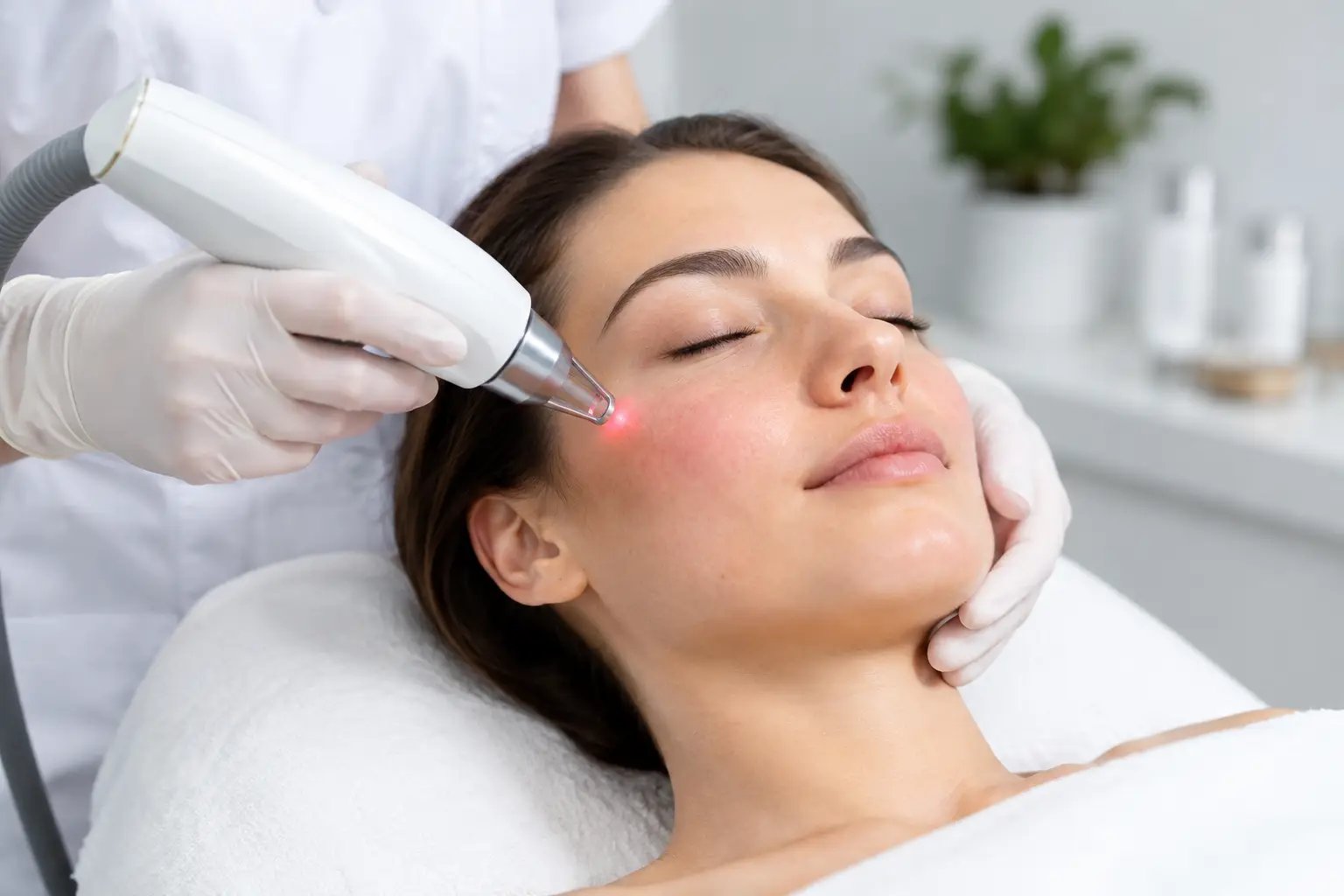
Plans generally begin with a consultation. A clinician generally reviews your history, triggers, medications, and skin tone before assessing the redness pattern.
A typical sequence looks like this:
- Consultation and skin assessment. Confirm the redness type and rule out conditions that need different care.
- Test spot. A small area is treated to gauge response and setting tolerance.
- First full session. Usually 20 to 45 minutes depending on area.
- Healing window. Redness or bruising settles over days to two weeks.
- Follow-up sessions. Spaced several weeks apart, often two to four in total.
- Maintenance. Periodic sessions to hold results, since new vessels can form.
Improvement may be seen after the first session, with the clearest change after the course is complete. At Balwin Aesthetics, care is personalized to your needs.
Risks, downtime, and who should avoid treatment
Laser and light treatments for redness carry potential risks, and honest counselling about them is important. Honest counseling matters more than optimism here.
Common and expected:
- Temporary redness or swelling for a day or two
- Bruising after pulsed dye laser, lasting up to a week or more
- Mild sensitivity in the treated area
Less common but worth knowing:
- Blistering or crusting if settings are too aggressive
- Pigment change, either lightening or darkening, especially in darker skin tones
- Scarring, rare with appropriate settings
- Reactivation of cold sores in people with a history of them
You should avoid or postpone treatment if you are pregnant or breastfeeding, have an active skin infection in the area, have taken isotretinoin recently, are photosensitized by medication, or have a history of keloid scarring. A clinician decides whether treatment is appropriate for you.
Preventing complications
Proper technique and aftercare can help reduce the risk of complications. To reduce risk:
- Disclose all medications, especially photosensitizing drugs like certain antibiotics and acne treatments.
- Avoid sun exposure and tanning beds for at least two weeks before and after treatment.
- Follow aftercare instructions precisely, including gentle cleansing and sun protection.
- Do not pick or scrub treated areas, which can cause scarring or prolonged healing.
- Report any blistering, severe pain, or signs of infection immediately.
When to postpone treatment
Treatment should be delayed if you have a sunburn, an active rash or infection in the area, or if you have recently used isotretinoin (typically within six months). If you are prone to cold sores, your clinician may prescribe antiviral prophylaxis. Pregnant or breastfeeding individuals should consult their physician before proceeding.
According to Health Canada’s guidance on medical device safety, devices used in clinical settings are regulated, and asking which device is being used and by whom is a reasonable question at any consultation.
Watch out: ignoring aftercare instructions or resuming active skincare too soon can turn a routine treatment into a longer recovery than necessary.
Book a facial redness consultation at Balwin Aesthetics
At Balwin Aesthetics, care is led by board-certified physician Dr. Sameer Sardesai.
We offer Lase MD laser, pigment laser, skin tightening, and a range of non-surgical treatments.
If you have been managing redness on your own and want a clear answer on whether laser treatment for facial redness is right for you, a consultation is the place to start. You can book your aesthetic appointment and get a plan built around your skin.
Redness rarely resolves on its own, and guessing at devices wastes both time and money. Balwin Aesthetics offers physician-guided assessment, personalized treatment planning, and a range of laser and light options under one roof. Get started with Balwin Aesthetics and find out which approach actually fits your skin.
Frequently Asked Questions
Does laser treatment help facial redness?
Laser and light treatments may help some people with facial redness. Vascular lasers and intense pulsed light target hemoglobin in enlarged or broken blood vessels. Diffuse flushing and fixed visible vessels usually respond best, while the pimple-like bumps of rosacea need separate management. Response varies with skin tone, the cause of your redness, and device choice, so a consultation with a qualified professional is the only reliable way to know what to expect in your case.
Is IPL or laser better for facial redness?
It depends on your redness pattern. IPL for facial redness covers larger areas in one pass and suits diffuse flushing and sun-related redness, with less bruising. Pulsed dye laser concentrates on discrete vessels, though bruising is more likely. Many clinics combine both. A clinician who assesses your skin tone and vessel type can recommend the right starting point rather than defaulting to one device.
How many laser treatments are needed for facial redness?
Many people need a series of sessions rather than a single one, because each treatment reaches only some vessels. The number of sessions depends on the redness pattern and how the skin responds. Your clinician will set a realistic number after seeing how your skin responds to the first session.
What should I ask a clinic before facial redness treatment?
Ask who performs the treatment and what their medical credentials are, which device they plan to use and why it suits your skin tone, how many sessions they expect, and what aftercare and downtime look like. Confirm how they handle complications and whether a physician oversees care. At Balwin Aesthetics, treatments are physician-guided, so you can ask directly about the assessment process before committing to a course of laser treatment for facial redness.

