
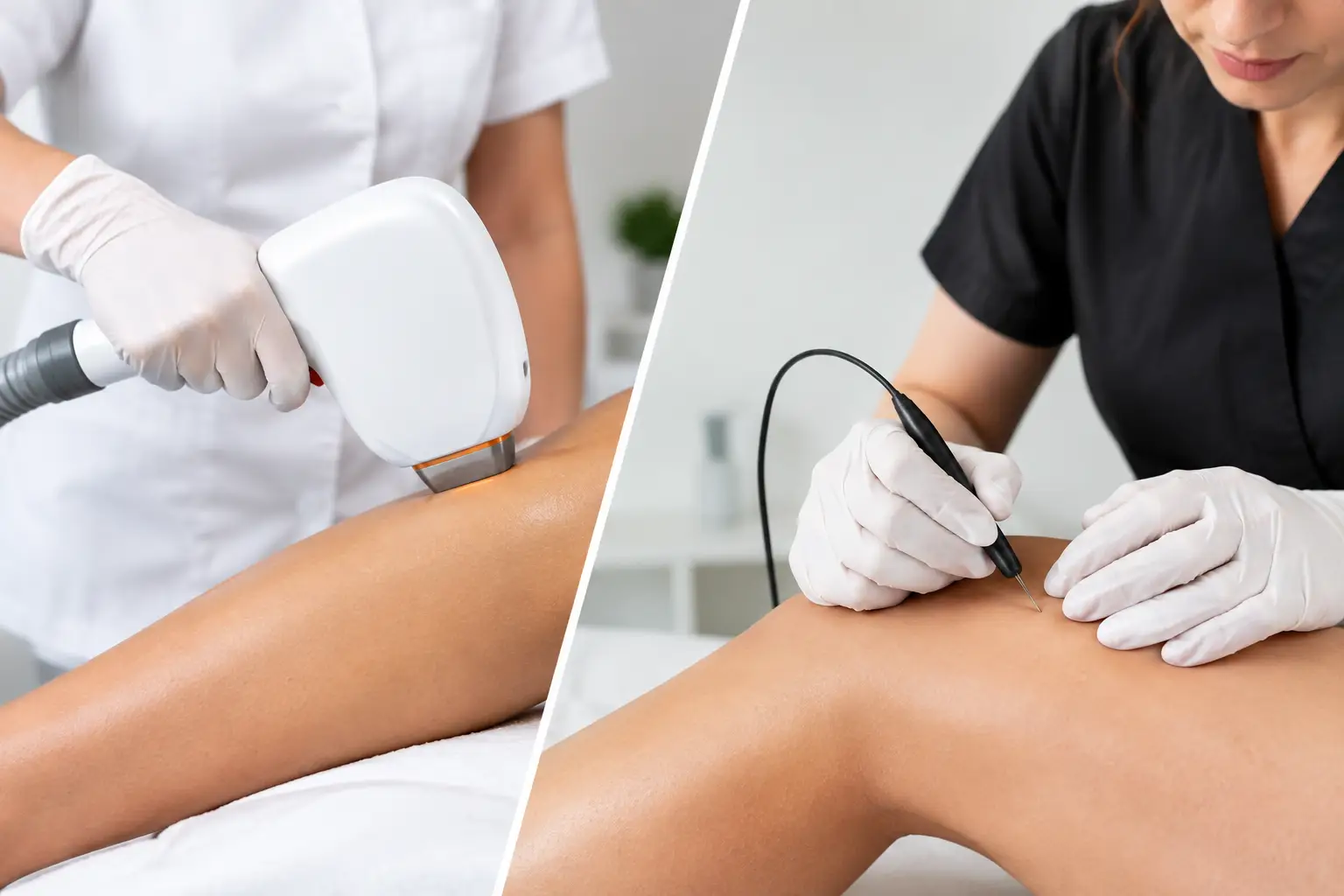
A few unwanted chin hairs can feel just as frustrating as a larger area of unwanted body hair, but they do not always call for the same solution. When considering laser hair removal versus electrolysis, the right choice depends less on which treatment is “best” overall and more on your hair color, skin type, treatment area, timeline, and desired level of permanence.
Both treatments can reduce the time you spend shaving, waxing, or tweezing. However, they work in fundamentally different ways. A personalized consultation helps determine which approach can provide the safest, most refined result for your goals.
Laser Hair Removal Versus Electrolysis: The Core Difference
Laser hair removal uses concentrated light energy that is absorbed by pigment in the hair. The energy travels down the hair shaft and heats the follicle, disrupting its ability to produce new growth. Because a laser can treat many follicles within one pulse, it is especially efficient for larger areas such as the legs, underarms, bikini line, chest, back, and arms.
Electrolysis treats one follicle at a time. A trained electrologist inserts a very fine probe into the follicle and applies a small electrical current to damage the growth center. The treated hair is then removed. This precise method does not rely on hair pigment, which makes it appropriate for hairs that lasers cannot reliably target.
The distinction matters: laser hair removal is generally considered a method of long-term or permanent hair reduction, while electrolysis is designed to permanently destroy individual follicles. Neither treatment can be evaluated fairly after a single session. Hair grows in cycles, and active-growth hairs respond best to treatment.
When Laser Hair Removal Is the Better Fit
Laser hair removal is often the practical choice for someone with noticeable hair across a broad area who wants a meaningful reduction in density with relatively efficient appointments. Treatments may take minutes for small areas and longer for larger areas, but they are considerably faster than treating each follicle individually.
Traditionally, lasers responded most predictably to dark, coarse hair against lighter skin because of the contrast in pigment. Modern medical-grade laser systems and appropriate settings can safely expand treatment options for a wider range of skin tones. Still, the device, wavelength, settings, and provider experience matter. Choosing treatment based on a promotional price rather than an appropriate assessment can increase the risk of irritation, pigment changes, or disappointing results.
Laser treatment is less effective on very light blond, gray, white, and red hair because these hairs contain little or no pigment for the laser to detect. Fine hair can also be less responsive than coarse hair. In these cases, continuing laser sessions without a clear treatment strategy may not be the best use of your time or budget.
Most patients need a series of laser treatments, commonly spaced several weeks apart, to address hairs as they enter their active growth phase. After the initial series, some people choose occasional maintenance treatments. Hormonal changes, genetics, and certain medical conditions can influence future hair growth, particularly on the face.
Areas laser treatment handles especially well
For the underarms, lower legs, bikini area, back, chest, and larger areas of the arms, laser hair removal often offers the strongest balance of speed and visible reduction. It can also be a good option for recurring ingrown hairs caused by shaving or waxing, provided the skin is assessed carefully and the treatment plan is appropriate.
Facial laser hair removal can be effective for dark, coarse facial hair, but it requires additional judgment. Fine facial hair and hormonally influenced growth may need a more selective approach. A qualified provider should discuss the possibility of maintenance and determine whether electrolysis may be better for isolated hairs.
When Electrolysis May Be the Better Choice
Electrolysis is particularly valuable when the hairs are light, gray, white, blond, or red. Since it does not depend on pigment, it can treat hairs that laser technology may miss. It is also a strong choice for small, precise areas, including a few unwanted hairs on the chin, upper lip, jawline, brows, or other facial areas where detail matters.
For patients who have completed laser hair removal but still have scattered resistant hairs, electrolysis can be an excellent finishing treatment. Rather than continuing to treat a large area with laser energy for only a handful of remaining hairs, electrolysis allows the provider to target those individual follicles directly.
The trade-off is time. Each hair must be treated separately, so clearing a dense area can require many appointments and patience. Total treatment time varies widely based on the size of the area, hair density, previous hair-removal methods, and consistency of appointments. It is not unusual for electrolysis to be a long-term commitment for extensive hair growth.
Comfort, Recovery, and Safety Considerations
Both treatments involve temporary discomfort, but the sensation is different. Laser hair removal is often described as a quick snap of heat against the skin. Many medical laser devices incorporate cooling to improve comfort and protect the skin. Electrolysis can feel like a brief pinch, heat sensation, or sting at each treated follicle.
After laser treatment, temporary redness and mild swelling around hair follicles are common and typically settle within hours to a couple of days. With electrolysis, pinpoint redness, tenderness, and minor swelling can occur, especially in sensitive facial areas. Small scabs may develop and should be allowed to heal naturally. Picking or aggressive exfoliation can increase the risk of marks or pigment changes.
Safety begins before treatment. Your provider should review your skin type, hair characteristics, current skincare routine, medications, history of cold sores if treating the face, and any tendency toward hyperpigmentation or scarring. Recent tanning, self-tanner, certain photosensitizing medications, and active irritation may require treatment to be postponed.
For both options, avoid plucking, waxing, or threading between appointments because these methods remove the hair from the follicle. Shaving is generally acceptable for laser hair removal because the root remains in place. Your provider will give area-specific preparation and aftercare instructions.
Comparing Cost and Time Commitment
A single laser appointment may cost more than a short electrolysis session, but cost should be evaluated in the context of the entire treatment plan. Laser often becomes more time-efficient for large areas because it treats multiple follicles at once. Electrolysis may be more cost-effective for a limited number of hairs or hair colors that do not respond well to laser.
Be cautious when comparing treatment packages without considering device quality, provider training, and customization. An improperly selected laser setting can lead to ineffective treatment or unnecessary risk. Likewise, electrolysis outcomes depend on careful technique and a consistent schedule. The lowest advertised price is not always the most economical path to a result you feel confident about.
Can You Combine Laser Hair Removal and Electrolysis?
Yes. For many patients, a combined strategy is the most efficient option. Laser hair removal can reduce the bulk of dark, coarse hair over a larger area, while electrolysis can address remaining lighter or finer hairs. This approach is often useful for facial hair, areas with mixed hair colors, or patients seeking the most complete long-term reduction possible.
The sequence should be individualized. A provider may recommend completing a laser series first, then reassessing the remaining hair before introducing electrolysis. In other cases, electrolysis may be the more appropriate starting point from the beginning.
Questions Worth Asking at Your Consultation
A thoughtful consultation should give you more than a quote. Ask which treatment is recommended for your hair and skin profile, what device or technique will be used, how many sessions may be reasonable, and what results are realistic for your specific area. You should also understand expected aftercare, possible side effects, and when maintenance may be needed.
If you have a history of melasma, post-inflammatory hyperpigmentation, keloid scarring, hormonal hair growth, or use prescription skincare products, bring that information forward. These details help shape a safer treatment plan and more accurate expectations.
The most satisfying hair-removal plan is not necessarily the fastest appointment on the calendar. It is the one that respects your skin, targets the hair you actually have, and gives you a clear path toward smoother skin with confidence.
