
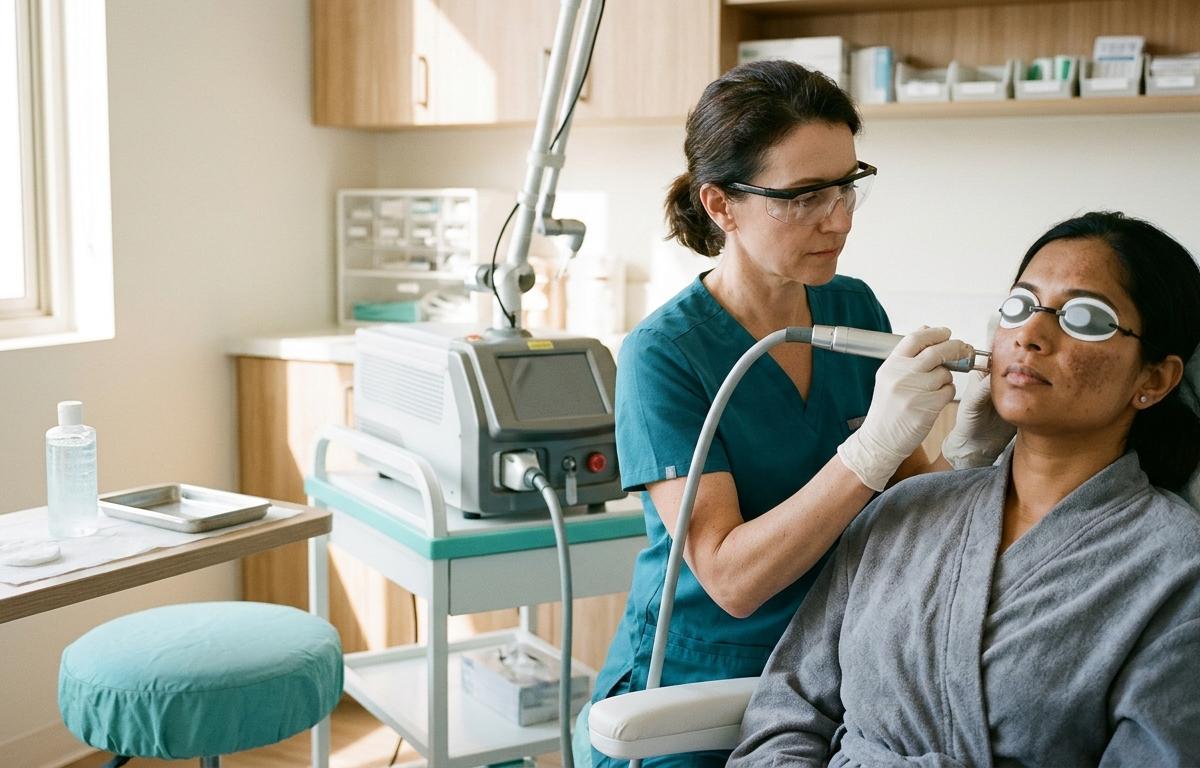
Why Laser Is Usually a Second-Line Option for Melasma
Melasma is a chronic, relapsing form of facial pigmentation, and the pigment cells are only part of the story. Hormones, sun exposure, heat and underlying changes in the skin all feed into it, which is why it responds slowly and not always predictably. The researchers who study it admit as much: there is no true gold standard treatment for melasma, a common skin problem that responds poorly to first-line therapies, according to a systematic review and meta-analysis of laser therapy.
That candid starting point shapes how a physician-led clinic approaches laser treatment for melasma. Laser is a recognized, widely used option, but it is rarely the first thing we reach for. Topical treatments and strict sun protection come first, and chemical peels often follow. Laser usually enters the picture when topicals as a first line and peels as a second line haven’t done enough, as Healthline’s overview of melasma lasers explains. The same source adds that even dermatologists don’t agree that laser suits every patient.
There is a practical reason for this order, too. Mayo Clinic’s dermatologists note that topical therapy should be used before any light or laser procedure and continued afterward to lower the risk of relapse, as described in their Q and A on treating melasma. Laser seldom works alone. It does its best work as one layer of a larger plan.
If you are early in your journey, our overview of the best treatment for melasma is a good place to see the full range of options before deciding whether laser belongs in yours.
Which Lasers Are Used and What the Evidence Shows
Not every laser is suited to melasma, and the choice of device matters a great deal. Vascular-specific lasers, built to target redness and visible vessels, don’t appear to be effective for melasma, according to a review of laser and light therapy in melasma. Matching the device to the type and depth of pigment is a clinical decision, not a cosmetic one.
A few categories come up most often in the research:
- Q-switched lasers. These have long been used for pigment. The same review found that Q-switched lasers need the greatest number of treatment applications before any benefit shows, which affects both cost and patience.
- Fractional non-ablative lasers. Mayo Clinic describes these as treating as little as 5% of the skin at a time, removing pigment gradually, with a much lower risk of relapse or worsening than harsher approaches.
- Picosecond lasers. These deliver extremely short pulses and are among the newer options. The reviewers single out picosecond lasers, fractional radiofrequency and laser-assisted drug delivery as promising future directions for melasma.
It’s worth being frank about how strong the evidence really is. A pooled analysis of laser-based therapies rated the overall certainty of evidence for its primary outcome as very low, because of the lack of blinding and high inconsistency between studies (systematic review and meta-analysis). Healthline likewise points out that laser trials for melasma are limited by small sample sizes.
What the literature does support is combining treatments. A review of lasers for melasma concludes that combination therapies, including oral or topical agents alongside lasers, give better results, and that maintenance treatment is crucial. Another analysis suggests that laser monotherapy, which targets only the pigment itself, may not be enough for long-term remission.
For our patients, the message is simple: the right laser, used gently and as part of a broader plan, can improve tone, but no single device should be sold as a cure.
Safety, Skin Type and Post-Inflammatory Hyperpigmentation Risk
The biggest safety concern with laser treatment for melasma is that the treatment itself can darken the skin. This is called post-inflammatory hyperpigmentation, and it is why laser has to be approached with caution, particularly in darker skin types, as the research on lasers for melasma points out.
Melasma-prone skin is also unusually reactive. Heat and inflammation can stir up the very pigment cells we’re trying to calm. The reviewers found that complications are often tied to high cumulative fluences or too-frequent treatment, which is why current practice has shifted toward low-fluence, carefully spaced regimens (meta-analysis of laser-based therapies). Gentle settings and enough time between sessions are protective.
Short-term side effects are generally mild and temporary. A network meta-analysis of laser-related therapy lists redness, swelling, burning, pain, scaling and itching as the typical adverse effects (Wiley network meta-analysis). They usually settle within days, but they should be talked through openly before treatment begins.
A thorough consultation should cover:
- Your skin type and any history of reacting to treatments or sun
- Whether you tan easily or have developed dark marks after irritation
- Any history of keloid or raised scarring, since people prone to keloids face a higher risk of added scarring from laser
- Current medications, hormonal factors and the topical products you use
Melasma can also overlap with other pigment or redness concerns. If you’re not sure what you’re dealing with, our page on laser treatment for pigment and vascular lesions describes how we assess different types of discoloration, and our guide to laser treatment for rosacea covers a condition that is sometimes mistaken for melasma. Getting the diagnosis right comes before choosing any device.
Recurrence, Maintenance and Daily Sun Protection
The most important expectation to set is this: melasma tends to come back. It is a chronic condition shaped by hormones and light, so clearing it with a series of sessions doesn’t mean it’s gone for good. The research is consistent that maintenance treatment is crucial to prevent recurrence (lasers for melasma review).
A sensible maintenance plan usually brings several elements together:
- Continued topical therapy. Mayo Clinic advises keeping up topical treatment even when laser or light procedures are recommended, specifically to reduce relapse.
- Daily broad-spectrum sunscreen. Worn every day, in every season, and reapplied when outdoors. With melasma, sunscreen isn’t optional; it is the foundation of the plan.
- Physical shade and protection. Hats and sunglasses help, because visible light and heat can also contribute to pigment.
- Periodic maintenance sessions. Some patients benefit from occasional gentle treatments, timed to keep tone even, as their physician advises.
Edmonton’s seasons add a few local wrinkles. Long summer days bring strong UV exposure, while winter brings snow glare and a tendency to skip sunscreen because it feels unnecessary. Melasma doesn’t take a winter break, so a steady routine matters year-round.
Supporting treatments can also help skin quality between laser sessions. Gentle options such as chemical peels are often part of a broader pigment plan, always chosen and timed carefully so they don’t provoke irritation. Your physician can advise which combination suits your skin and how to sequence it safely.
For patients, the honest framing is long-term management. A good result is calmer, more even skin that stays that way because of the habits built around it, not a one-time reset.
Choosing a Physician-Led Clinic in Edmonton and Setting Realistic Results
Melasma is easy to worsen and hard to resolve, so who treats you matters as much as which device is used. A physician-led clinic can examine your skin, confirm the diagnosis, decide whether laser is appropriate at all, and recommend alternatives when it isn’t. That judgment counts for a lot given how limited and variable the evidence is.
When comparing clinics in Edmonton, a few direct questions help:
- Will a physician assess my skin and confirm that this is melasma before any treatment?
- Which device do you recommend for my skin type, and why?
- What settings and spacing do you use to minimize the risk of darkening?
- What is my topical and sun protection plan before, during and after treatment?
- How many sessions should I realistically expect, and what happens if the pigment returns?
Be wary of any provider who promises permanent removal or dramatic results after one or two visits. Some device categories need many applications before a benefit appears, and relapse is common, so an honest provider will talk about gradual improvement and ongoing care.
Realistic results usually mean softer, lighter, more even pigment over a series of treatments, backed by consistent home care. They don’t mean a guarantee that melasma will never return. Some patients find that pairing laser with topicals or with skin-renewing treatments like microneedling gives smoother overall results, though the plan should always be individualized.
At Balwin Aesthetics, we start with a consultation focused on your skin, your goals and your history, so any recommendation rests on what is safest and most likely to help. If you’re weighing laser for stubborn pigmentation and would like a physician’s opinion, you can contact our Edmonton clinic to book a consultation and talk through whether laser treatment for melasma is a sensible next step for you.
