
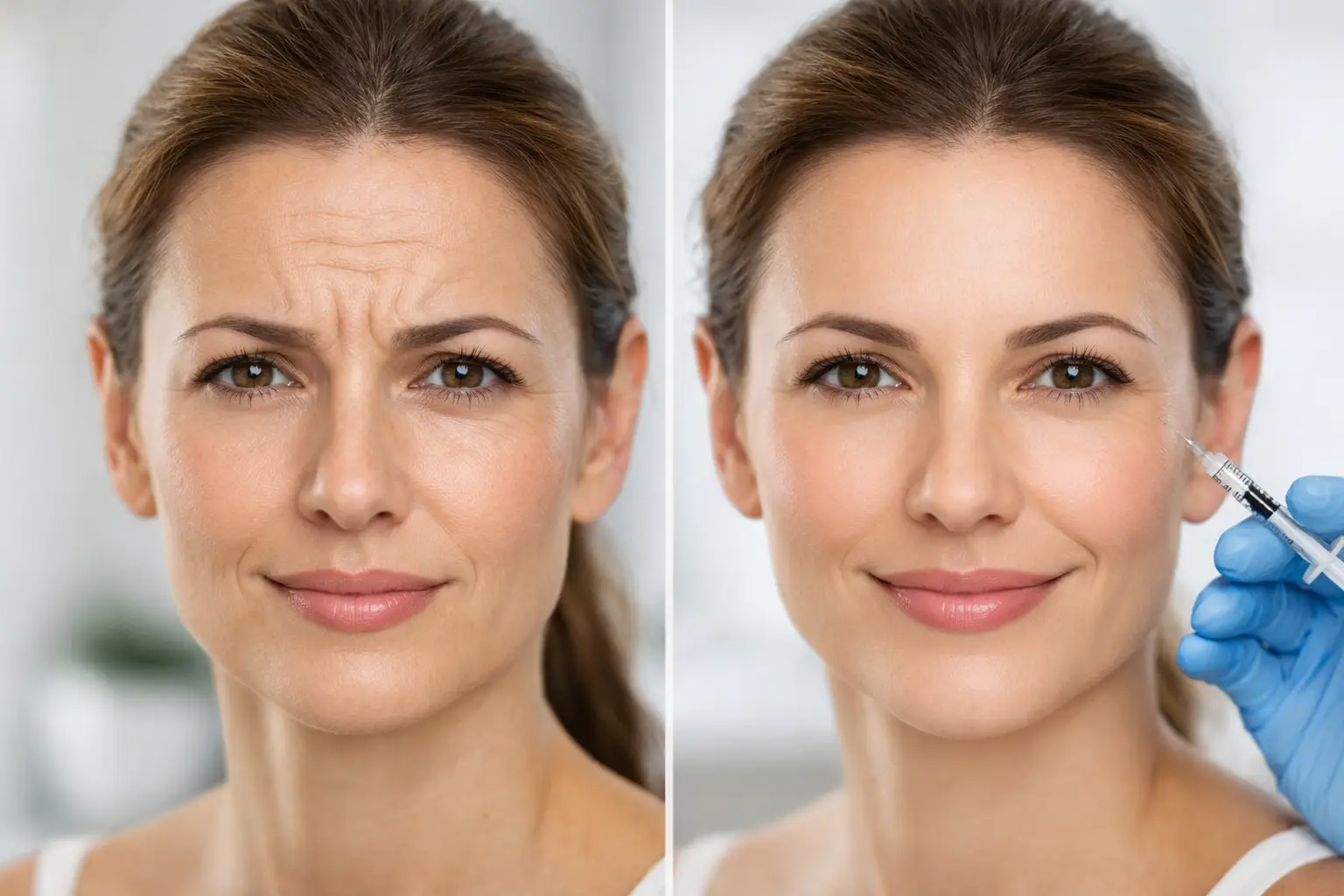
A forehead treatment can look dramatic in photos for the wrong reason: a frozen expression may be mistaken for a successful result. A useful botox forehead before after example should show something more refined – softened horizontal lines, a rested appearance, and enough movement to look like yourself when you raise your brows.
The goal is not to erase every sign of expression. It is to reduce the repeated muscle contraction that folds the skin, while preserving facial balance and an expression that feels natural. The best outcome depends on your anatomy, the depth of your lines, your brow position, and the experience of the medical injector planning your treatment.
What a Botox Forehead Before After Example Can Show
The forehead develops horizontal lines when the frontalis muscle lifts the eyebrows. Over time, those dynamic lines can become visible even when the face is at rest. Botox temporarily relaxes targeted portions of this muscle, helping the skin lie smoother and limiting the repetitive movement that contributes to deeper creasing.
In a typical before image, the person may have noticeable lines only when raising their eyebrows, or they may have etched lines that remain visible without movement. The after image, usually taken once results have settled, may show a smoother forehead at rest and visibly softened lines with animation. The eyebrows should still lift, although often with less force than before.
A high-quality result is not necessarily a perfectly blank forehead. If the muscles are treated too aggressively, the forehead can appear overly still or the brows may feel heavy. A thoughtful treatment plan respects the role the forehead muscle plays in lifting the brows, especially in patients whose brows naturally sit lower or whose upper eyelid skin is heavier.
Timing Matters When Looking at Results
Botox does not create its full effect immediately after injections. Some people notice early changes within three to five days, but the effect continues to develop over roughly 10 to 14 days. This is why an immediate post-treatment photo is not a meaningful “after” example.
At the two-week point, the forehead should look calmer and smoother. Fine lines caused mainly by movement may be significantly reduced. Deep, established lines may improve but not disappear completely after one treatment, because the skin itself has been folded repeatedly over years. In these cases, consistent treatment, sun protection, and a personalized skin renewal plan may help improve the overall appearance over time.
Results commonly last about three to four months, though duration varies. Metabolism, muscle strength, treatment dose, and how regularly someone receives treatment can all influence how long the effect remains visible. As movement gradually returns, it is normal for lines to reappear gradually rather than all at once.
The Difference Between Natural and Overdone Forehead Botox
Natural-looking Botox is planned around facial movement, not simply around a number of units. Two people with the same forehead lines may need very different approaches. One may have a strong frontalis muscle and high brows; another may rely heavily on the forehead to keep the brows elevated.
During a physician-led consultation, the injector should assess your face at rest and in motion. You may be asked to raise your brows, frown, and relax so the muscle pattern and brow position can be evaluated. This assessment helps determine where treatment may be appropriate and where restraint is essential.
A refined result often includes softening the forehead in coordination with the glabella, the area between the eyebrows sometimes called the “11 lines.” Treating one area without considering the other can create an unbalanced look. The forehead and brow complex work together, so the plan should account for the full upper face rather than treating a wrinkle in isolation.
Why Your Results May Not Match Someone Else’s Example
Before-and-after images are helpful for setting expectations, but they are not a treatment blueprint. Facial anatomy differs substantially from person to person. Skin thickness, wrinkle depth, brow shape, prior treatment history, and muscle activity all affect the final result.
For example, a patient in their 30s with lines visible only when expressive may see a very smooth forehead after treatment. A patient with deeper resting lines may see substantial softening while retaining faint creases in certain lighting. Neither result is necessarily better – they reflect different starting points and realistic treatment goals.
Dosage also should not be judged by a friend’s treatment or a social media image. More Botox is not automatically better. An appropriate dose is the one that supports your goals while protecting natural expression and brow position. Some patients prefer a softer, more animated look, while others want stronger reduction of movement. Both preferences can be discussed openly during a personalized consultation.
What to Look for in Before-and-After Photos
When reviewing a Botox forehead before after example, look beyond the wrinkle itself. Credible images should be taken in similar lighting, with a comparable angle and facial expression. A relaxed before image should be compared with a relaxed after image; an animated before image should be compared with the same animated expression after treatment.
Pay attention to the brow shape and eyelid area as well. The most successful forehead treatment generally looks balanced, not artificially elevated or noticeably heavy. The person should appear refreshed, not like they have had to stop using their face.
It is also reasonable to ask when the after image was taken. Photos captured at approximately two weeks provide a clearer indication of the established result than photos taken a day or two after treatment. Be cautious with highly filtered images, dramatic changes in lighting, or comparisons that do not show equivalent expressions.
Preparing for a Forehead Botox Appointment
A consultation is the right place to discuss your desired level of movement, prior injectable history, medical conditions, allergies, and medications or supplements. Your clinician may advise you on preparations based on your individual health history. Do not stop prescribed medication without guidance from the clinician who manages it.
The appointment itself is typically brief. Botox is placed with a very fine needle at carefully selected points in the forehead and, when appropriate, nearby upper-face muscles. Most patients describe the sensation as quick, mild pinches. There is generally no significant downtime, although small raised areas, pinpoint redness, or minor bruising can occur temporarily.
After treatment, follow the aftercare instructions provided by your clinic. Patients are commonly advised to avoid rubbing or massaging the treated area and to postpone strenuous activity for a period recommended by their injector. If you have questions about an unusual symptom or your recovery, contact your treating clinic promptly.
Safety Starts With Proper Assessment
Botox is widely used for cosmetic treatment, but it remains a prescription medical product. Safe, natural results depend on appropriate patient selection, product handling, dosing, and injection technique. Treatment may not be suitable for everyone, including people with certain neuromuscular conditions, active skin infections at the injection site, or particular medical circumstances. Pregnancy and breastfeeding considerations should be discussed directly with a qualified medical professional.
Potential side effects can include temporary bruising, swelling, headache, asymmetry, or unwanted brow or eyelid heaviness. These concerns are uncommon when treatment is carefully planned, but no injectable procedure is risk-free. Choosing an experienced, medically qualified provider gives you the benefit of a proper assessment and a clear plan if follow-up is needed.
A conservative first treatment can be especially valuable for patients who are new to Botox or concerned about looking overdone. Once your response is assessed at follow-up, future appointments can be tailored with greater precision. This measured approach often produces the most elegant long-term results.
Your best before-and-after comparison is not someone else’s photo. It is a plan built around your own expressions, skin, brow position, and comfort level – so your forehead looks smoother while your face still looks unmistakably like you.
